

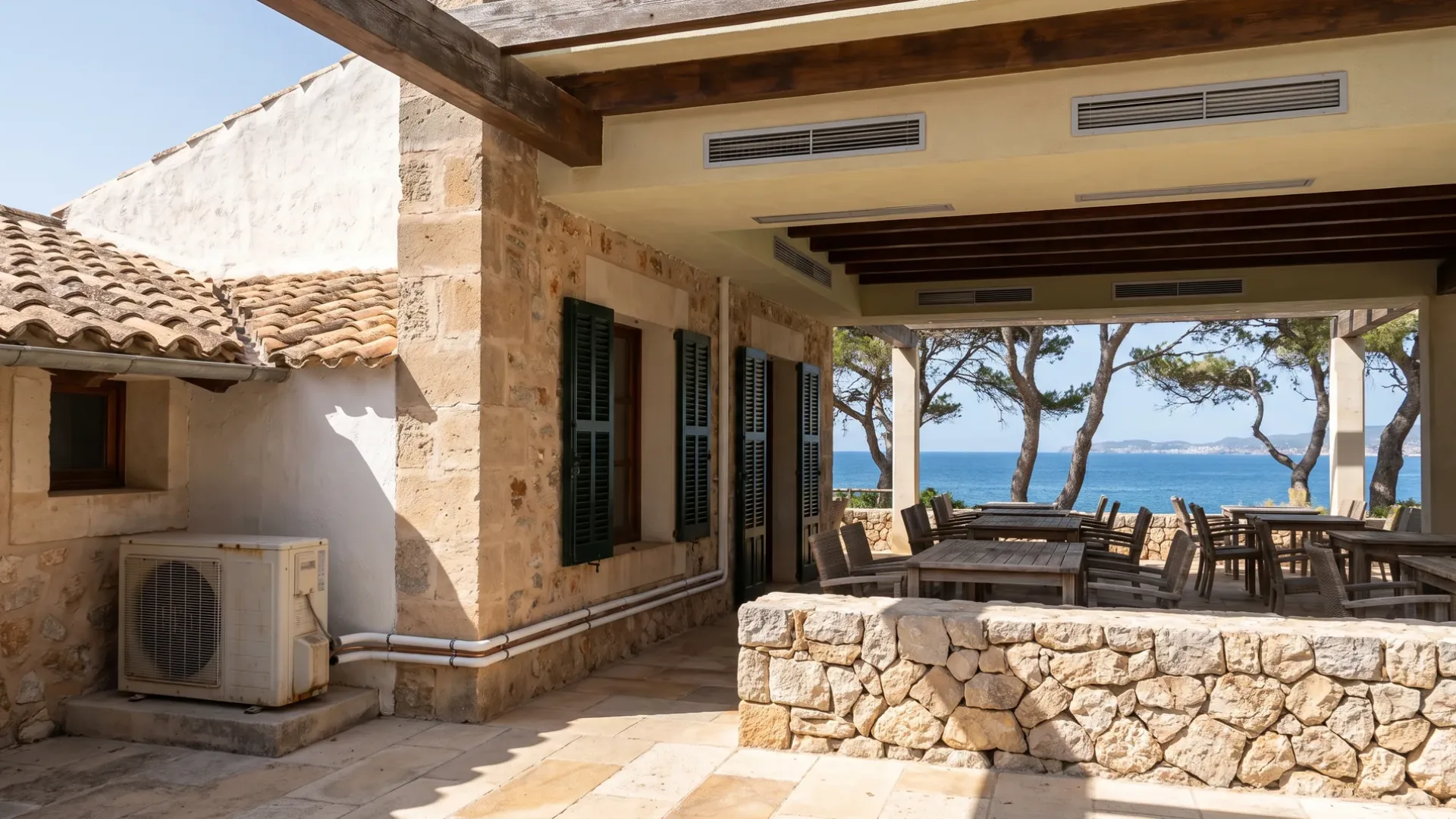
Climate Control for Hotels and Hospitality in Mallorca
A hotel is not one building climate. It is thirty or a hundred small ones that guests control themselves, plus a handful of large public spaces that nobody should be able to touch, plus a kitchen pushing heat into a dining room. Describe the premises and we pass the request to air conditioning and heat pump companies that take on hospitality work.
request describes the job
companies see it
for you, always
obligation to accept
Guest rooms and public spaces are opposite problems
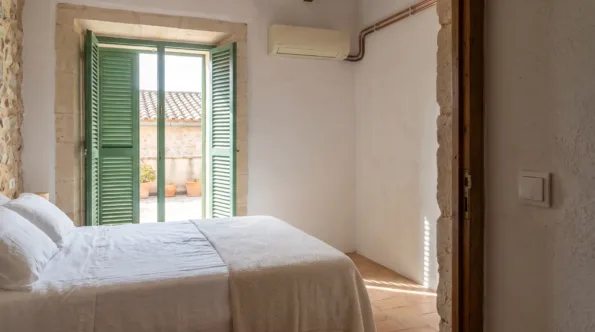
A guest room has to be individually controllable, because guests expect it and because a room that cannot be adjusted generates complaints regardless of how comfortable it actually is. It also has to be efficient when nobody is in it, which is most of the day, and that is where linking control to occupancy earns its keep.
A public space is the opposite. A lobby, a restaurant or a bar has a load that swings enormously with the number of people in it, doors that open constantly, and nobody who should be adjusting anything. It wants central control, generous capacity for the busy hour, and a thermostat that guests and staff cannot reach.
Getting these the wrong way round is the commonest problem in older hotels: guest rooms on a central system that suits none of them, and a restaurant with a thermostat beside a table that gets moved every evening.
What hospitality climate control has to deal with
- Guest control in rooms, without every room running at its coldest all day
- Occupancy linking, so an empty room is not conditioned to a guest setting
- Public spaces sized for the busy hour rather than the average one
- Kitchen heat, and the doorway it travels through
- Doors and terraces open through the whole service
- Plant that must not be heard from a terrace or seen from a courtyard
- A closed season, which is the only window for real work
- Work in occupied floors, done around guests rather than instead of them
- A service arrangement, because a failure closes rooms
- Somebody on the staff who has to be able to operate it
How a hospitality project usually has to be planned
The calendar constrains this work more than the building does.
-
01
Survey against peak occupancy
What the premises look like when they are full, not when they are empty. Load in a hotel is mostly people, and a survey in February measures the wrong building.
-
02
Decide who controls what
Guest rooms, staff areas and public spaces, each with its own answer and its own limits. This is agreed before the plant is chosen, because it changes what is needed.
-
03
Work out the window
Closed season, quiet weeks, or floor by floor while the hotel stays open. Each is a different programme and a different price, and the honest quote states which it assumed.
-
04
Phase around the business
Rooms come back into service as they are finished, public spaces are done between services, and noisy work is timetabled rather than negotiated daily.
-
05
Commission under something like real load
A system balanced in an empty hotel is balanced for a hotel nobody is in. The first busy week is the real test, and it is worth planning to be present for it.
-
06
Hand over to staff who will use it
What may be changed, what may not, and who to call. A system nobody on the staff understands gets overridden within a fortnight.
Related
Commercial climate control
Smart climate control
The season is the constraint, and it is booked early
A large share of hospitality work here happens in the same short window between one season and the next, which means every hotel on the island wants the same weeks from the same companies. Availability rather than capability is usually what decides who is free, and it is decided long before the specification is finished.
That has a practical consequence worth stating plainly: for work that has to be finished before a season, the sensible order is to secure the company first and complete the detail afterwards. Waiting until the design is perfect and then looking for somebody is how a project slips a whole year.
It also affects what is worth doing at all. A phased plan that improves the worst rooms this winter and the rest next is often a better outcome than a complete scheme that misses its window and is done in a hurry.
How your request reaches a company
Mallorca Climate Control is a comparison service. A request for a hotel or hospitality climate control project goes to the air conditioning and heat pump companies on our list; they quote the work and carry it out, and any agreement is between you and the company you pick.
-
01
Describe the job
Tell us the property, roughly what you want and where it is. Photographs and a rough plan help, though neither is required.
-
02
We match it
The request goes to companies that work in your area and take on this kind of job at this size.
-
03
They quote you
Each company contacts you directly with its own price, timing and approach. We do not set any of it.
-
04
You compare and choose
Put the quotes side by side and take the one you want, or none of them. Using the site costs you nothing.
Can guest rooms have individual control without wasting energy?
Yes, and the two are usually specified together. Individual control with sensible limits, linked to whether the room is occupied and to whether the balcony door is open, gives guests what they expect while stopping empty rooms being conditioned all day. Control without those links is where the running cost goes.
How is a restaurant sized differently from a dining room at home?
On people and on the kitchen. A full restaurant is a room of bodies with a hot doorway at one end and a street door opening every few minutes, and none of that appears in the floor area. The sizing conversation should be about the busy service, not about the square metres.
Can the work be done without closing?
Usually, in phases, and it takes longer and costs more. Rooms come back as they are finished and public spaces are done between services. Where there is a closed season, using it is almost always the better answer, and it is worth planning a year ahead.
Is ventilation part of this?
It is separate from cooling and in hospitality it is often the more important half, particularly where there is cooking, smoke or high occupancy. A brief that asks for cooling alone in a space that also needs air changed is answering half the question.
What should the service arrangement cover?
How often somebody attends, what is checked on each visit, what happens between visits when something stops, and who holds spares for the equipment installed. Those four are worth comparing across offers rather than the headline figure.
Get climate control quotes for a hotel or restaurant
Describe the premises and how they are used, and let several companies price the same brief.