

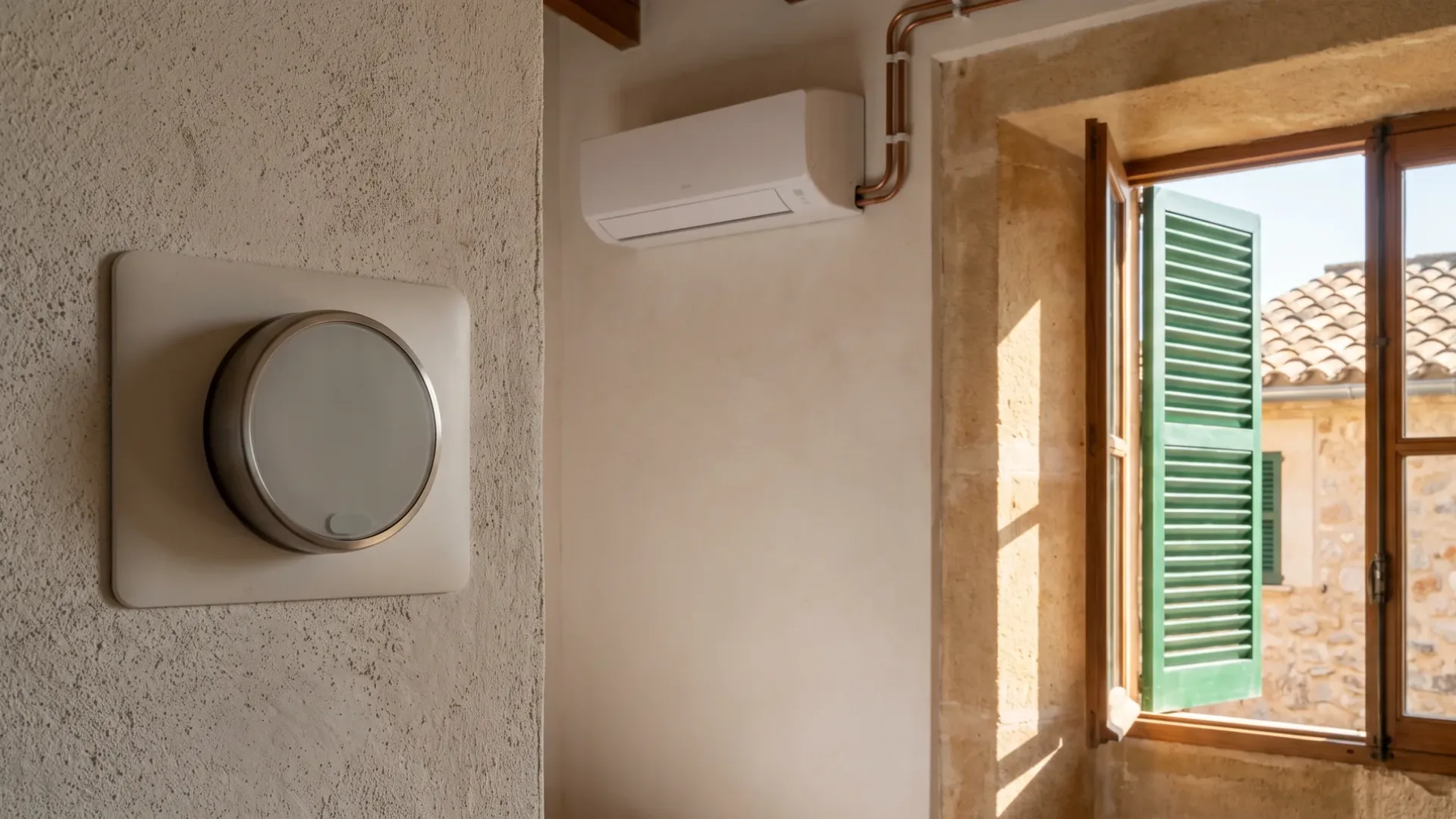
Smart Thermostats
A thermostat decides when equipment runs and at what temperature it stops. A smart one does that from an app or a schedule rather than a dial on the wall, which means heating or cooling from away from the property and running to a timetable that matches when somebody is actually in the house. It matters what is on the other end of the thermostat, because a smart control on a single air conditioning unit does something very different from the same control on a whole property.
request describes the job
companies see it
for you, always
obligation to accept
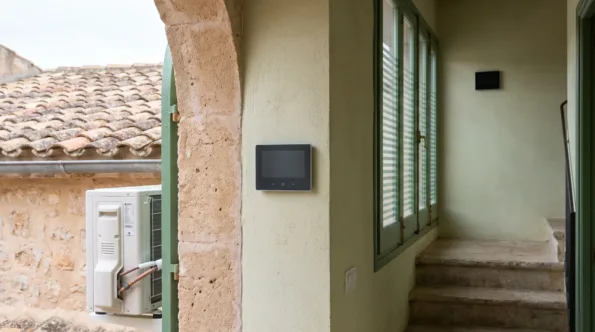
What a thermostat does on a split system
A split air conditioning unit has an indoor controller with its own thermostat, and that is the thing a smart upgrade touches. The thermostat reads the air temperature in one room and tells the unit to run until that room is at the set temperature, then stops it. A smart one does the same, but the setpoint comes from an app or a schedule instead of a dial.
The limit is built in. The thermostat cannot tell the unit what the other four rooms are doing or whether anybody is in them. It controls one unit. If the property has four separate outdoor units, four separate rooms are controlled separately, which is already a form of zoning and is what most split installations are: one unit, one room, one thermostat.
On a multi-split serving four rooms from one outdoor unit, the thermostat reads one room and asks the machine to run at part load to satisfy that one point of control. If three rooms are occupied and one is shut off, the system is not optimised for three rooms; it is chasing the temperature setpoint in whichever one has the thermostat sensor.
What a smart thermostat usually offers
- Setting temperature from an app instead of walking to the wall
- Scheduling by day or by the hour, so the system only runs when it needs to
- Presence sensing, so the temperature adjusts when somebody leaves home
- Predictive heating or cooling, bringing the property to comfort before arrival
- Remote access from another country, provided there is internet at the property
- Monitoring, so you see what the thermostat is reading and when the system ran
- Integration with other smart-home devices, though the thermostat still controls only itself
- Alerts when the temperature drifts outside the range you set
Setting up a smart thermostat schedule
The schedule works only if it matches the way the property is actually lived in, which is why a generic weekday-weekend pattern often fails.
-
01
Define the property rhythm
Is the house occupied every day, empty during work hours, or closed for months? Does somebody live here or is it a second home? A schedule that expects occupation on Tuesday has missed the point if the property is empty all week and full at weekends.
-
02
Set the temperatures
Comfort temperature when occupied, and how much lower the background can be when the house is empty. On a property that is shut for three months, a background temperature only has to prevent damage, not suit comfort.
-
03
Choose the times
When does the property wake, and when does it go to sleep? A schedule that brings a villa to comfort at 8 a.m. on Saturday might bring it to comfort at 6 a.m. on Monday because the pattern was copied from a five-day week.
-
04
Test it
Let it run for a week against the real property rhythm, then adjust. A schedule that assumes occupation and has nobody home is both uncomfortable and expensive.
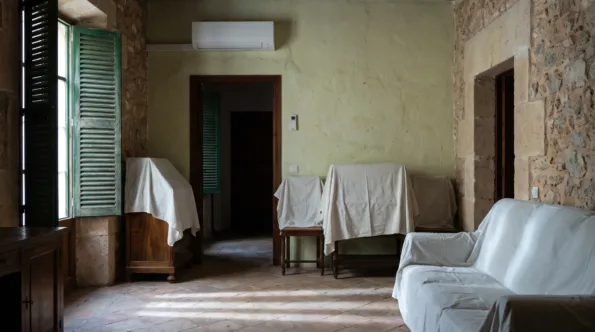
The honest limit of a smart thermostat on one unit
A thermostat on a single air conditioning unit controls only that unit, in only that room. If the thermostat is in the living room and the bedrooms are controlled by the same outdoor unit running at part load, raising the setpoint in the living room does not tell the system to condition the bedrooms harder. It tells the one unit to stop sooner because the living room is warm enough.
This is not a failure of the thermostat. It is the shape of the job. A thermostat measures temperature and asks the equipment to run or stop. It does not rebalance how much cooling four rooms are sharing. That is a zoning question and it belongs to the system design, not to the controls.
A smart thermostat on one unit saves money by not running it when nobody is home and by scheduling it to occupy weather rather than calendar time. A zoned system with separate outdoor units or dampers, each with its own thermostat, saves money by not conditioning empty rooms. One thermostat cannot do the second, because it reads only one point in the building.
Related topics in smart climate control
Zoning
Smart home integration
Heat pumps
How your request reaches a company
Mallorca Climate Control is a comparison service. A request for smart thermostat setup goes to the air conditioning and heat pump companies on our list; they quote the work and carry it out, and any agreement is between you and the company you pick.
-
01
Describe the job
Tell us the property, roughly what you want and where it is. Photographs and a rough plan help, though neither is required.
-
02
We match it
The request goes to companies that work in your area and take on this kind of job at this size.
-
03
They quote you
Each company contacts you directly with its own price, timing and approach. We do not set any of it.
-
04
You compare and choose
Put the quotes side by side and take the one you want, or none of them. Using the site costs you nothing.
Will a smart thermostat reduce my electricity bill?
If the property was being run all the time, yes, because a schedule stops it when nobody is home. If the property was already being controlled by a basic timer, the saving is smaller. The biggest saving comes from zoning, where it is unnecessary, or from schedule calibration, which is free.
Can I schedule a thermostat for a second home that is empty most of the year?
Yes, but the schedule has to match the property rhythm, not a working week. A schedule that wakes the house every day is expensive when the house is empty four days a week. Presence sensing or manual overrides let you adapt the schedule when you actually arrive.
What is the difference between a smart thermostat and zoning?
A thermostat controls when equipment runs. Zoning controls which rooms get air or heat. A smart thermostat on a single unit does the first; zoning does the second. Both can be smart, and a property with zoning benefits more from a smart schedule because there is more to control separately.
Do I need WiFi for a smart thermostat?
Not to run the schedule. The thermostat can store the schedule locally and follow it without internet. WiFi is only needed if you want to change it from an app or if you want remote monitoring. If the internet goes down, the schedule keeps running.
What happens if the internet goes down?
A well-designed system runs its stored schedule and still accepts manual commands from the wall. This is worth asking about explicitly, because it separates systems where cloud control is a convenience from systems where it is required.
Get smart thermostat quotes
Describe what is installed and how the property is used, and let companies show you what a smart control could do.