

Remote Climate Control
Remote climate control means operating the system from somewhere else, usually from a phone. For a property that is occupied most of the year it is a convenience. For a property that is empty three-quarters of the time it is closer to necessary, because a house with nobody in it is a different problem: it can be left cold and damp, or left running at comfort temperature for nobody, or held at a background condition with alerts to say if something goes wrong. That last option is what remote control is usually for.
request describes the job
companies see it
for you, always
obligation to accept
What remote control does for an absent property
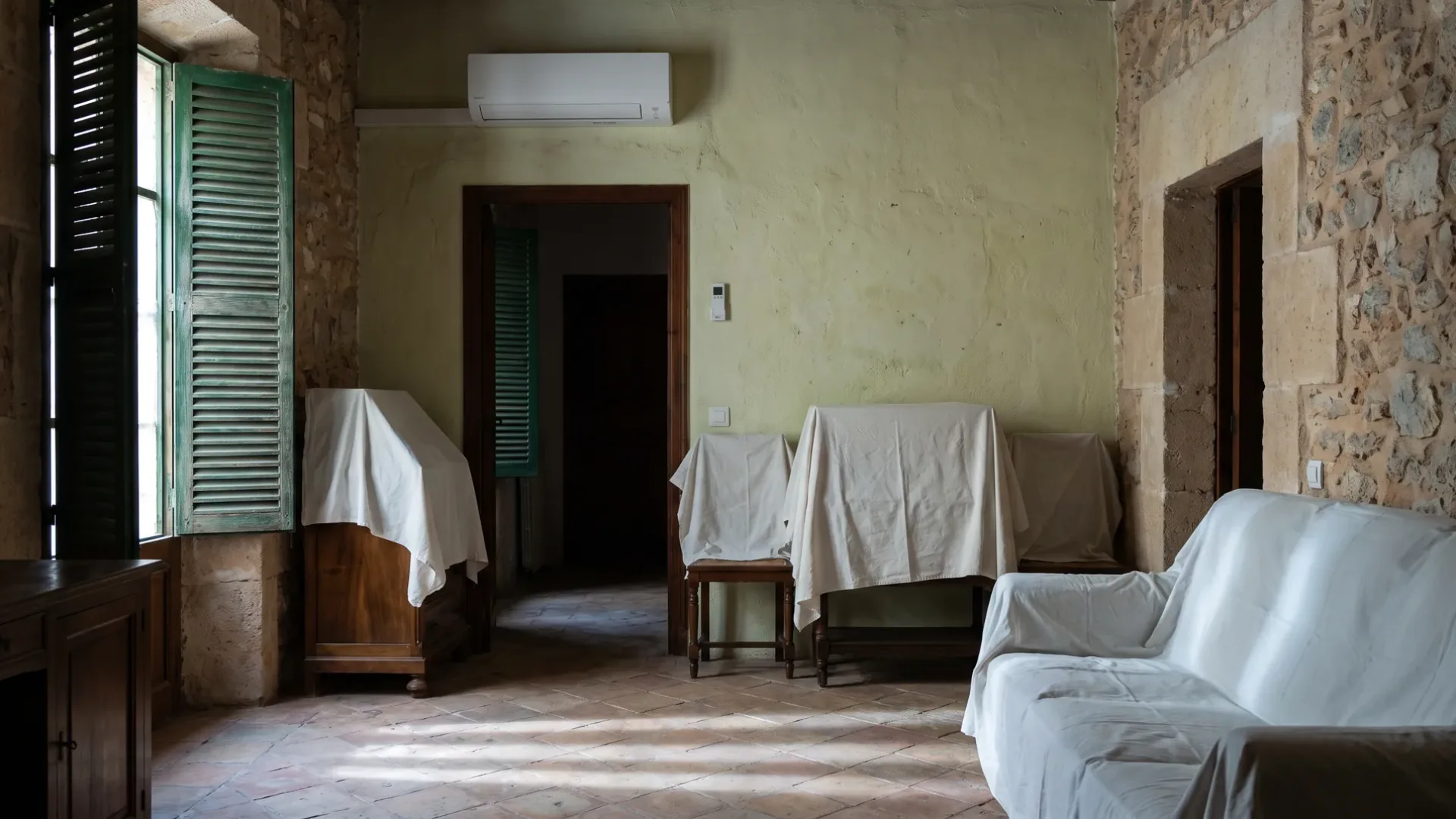
A property with nobody in it for three months develops problems if it is left unheated and unmonitored. Stone walls and tile floors hold moisture, condensation gathers on cold surfaces, and mould starts. Running it at full comfort temperature all that time is a different kind of expensive. The middle answer is a system that holds a sensible background condition, reports what is happening, and can bring the property to comfort before anybody arrives.
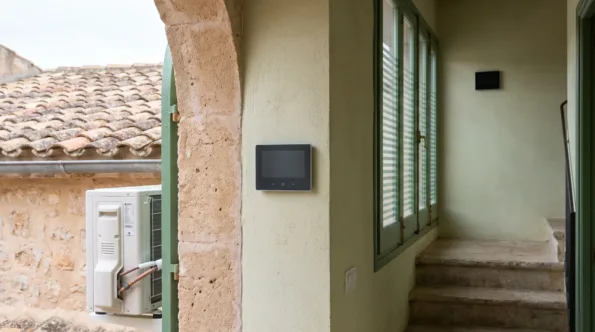
Remote control makes that possible. A schedule can hold the property at a temperature that prevents damp without the cost of full conditioning: here that means holding humidity down rather than holding the rooms warm. A sensor tells the owner if those conditions are being held and alerts them if they drift. Two days before the owner is due to arrive, they can raise the setpoint from an app and the house will be at comfort when they arrive.
The alerts are the important part. A property left completely shut is still a property being run, and something can go wrong: a heat pump or a split unit fails silently, or a window is left open and the system cannot hold the condition. An alert that says the temperature or humidity has been drifting for hours is intelligence at a distance. Without it, the problem is discovered on arrival, which on a property three time zones away is too late.
What remote control usually includes
- Setting the temperature and schedule from an app rather than on the wall
- Monitoring what the system is doing and what the sensors are reading
- Alerts when temperature or humidity drift outside the range the owner set
- Historical data, so the owner can see what the property was doing while they were away
- Predictive control, bringing the house to comfort before arrival without running it all the time
- Manual overrides, so the owner can make quick adjustments without changing the schedule
- Integration with other smart systems, so one app can see multiple properties
- Fallback operation if the internet goes down, so the schedule keeps running locally
Setting up remote control for an absent property
The setup is simpler than occupancy, because an absent property is simpler: two temperatures instead of a complex schedule.
-
01
Confirm internet access
Remote control needs reliable connectivity at the property, and Mallorca has gaps. A property with poor signal cannot be controlled reliably from away. Check that the property network can reach the system and stay connected.
-
02
Choose the background condition
What temperature and humidity protect the property without running it hard? For most stone buildings on the island, holding above 15C and below 80% humidity is enough. For properties with art or sensitive items, it is more stringent. This becomes the away-mode setting.
-
03
Set up monitoring
The thermostat needs to report what it is reading, which usually means cloud connectivity or a local display that somebody can read. The alerts have to go somewhere the owner will see them in real time.
-
04
Plan the arrival sequence
Two days before arrival, what temperature and humidity should the property be at? Building that into the schedule means the system brings comfort without the owner having to think about it.
-
05
Test the fallback
Simulate a loss of internet and confirm the system keeps running the background schedule. A system that stops entirely when disconnected is not safe for an absent property.
What remote control will not do
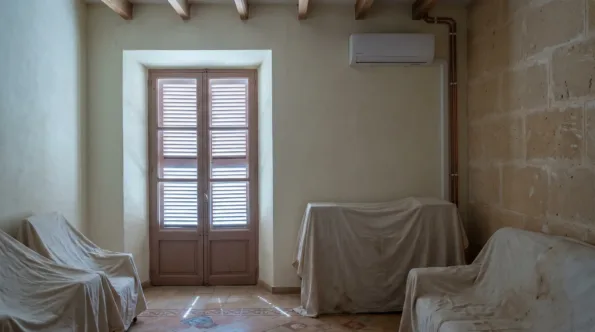
Remote control cannot fix a system that has failed. If the outdoor unit stops working, lowering the setpoint from the app does nothing, and the owner will find out when they arrive. Monitoring tells them the failure happened, which is useful, but it does not prevent it. A property that is visited twice a year needs a way to ask for help urgently if something fails.
Remote control also cannot overcome poor internet. If the property network is unreliable, commands will fail, monitoring will be sporadic, and alerts might be delayed. A property with marginal signal is worse off with a remote-control system than without it, because the owner has false confidence that they can manage it from away.
The system is also no substitute for a caretaker visit. An alert that the humidity is high might mean a burst pipe or an open window, and an app will not fix either. A property that is visited twice a year still needs a person to walk through it and confirm that nothing is visibly wrong, or to call somebody who can. Remote control is additional to that, not instead of it.
The three use cases for absent properties
Remote control works differently depending on who owns the property and who lives in it.
Second homes
Holiday rentals
Property managers
How your request reaches a company
Mallorca Climate Control is a comparison service. A request for remote climate control goes to the air conditioning and heat pump companies on our list; they quote the work and carry it out, and any agreement is between you and the company you pick.
-
01
Describe the job
Tell us the property, roughly what you want and where it is. Photographs and a rough plan help, though neither is required.
-
02
We match it
The request goes to companies that work in your area and take on this kind of job at this size.
-
03
They quote you
Each company contacts you directly with its own price, timing and approach. We do not set any of it.
-
04
You compare and choose
Put the quotes side by side and take the one you want, or none of them. Using the site costs you nothing.
Does remote control work if the internet goes down?
It depends. A well-designed system carries the schedule locally and keeps running it even if cloud connectivity is lost. You lose the ability to change it remotely and you might lose alerts until internet returns, but the property keeps holding the background condition you set. Always ask this explicitly, because it separates systems where cloud is optional from systems where it is required.
What temperature should I hold an empty house at?
Freezing is not the risk here; damp is. The useful target is not a temperature at all but a humidity band, held steadily rather than corrected in bursts, and a temperature that simply keeps the building from sitting cold enough for surfaces to run with condensation. The exact answer depends on the building and what is in it, but it should be treated as a specification question, not an afterthought.
Will I get alerted if something breaks?
Yes, if the thermostat is monitoring temperature and humidity and configured to alert. No, if the monitoring is broken or not set up. A system that stops running silently will not trigger an alert about itself. This is why a property that is visited twice a year still needs a person to walk through it.
Can I bring the house to comfort before I arrive?
Yes, with a schedule that steps the temperature up one day before arrival, or by raising the setpoint manually when you know you are coming. Some systems can predict when you are arriving based on your calendar or location. This is a specification question that belongs in the brief.
Is remote control secure?
It can be. The same technologies that cloud systems use for other applications apply here: encryption over the network, secure login, and audit trails of who changed what. It is worth asking a company how they secure remote access rather than assuming they do.
Get remote control quotes
Describe the property and how often it is occupied, and let companies show what remote monitoring and control could do.