

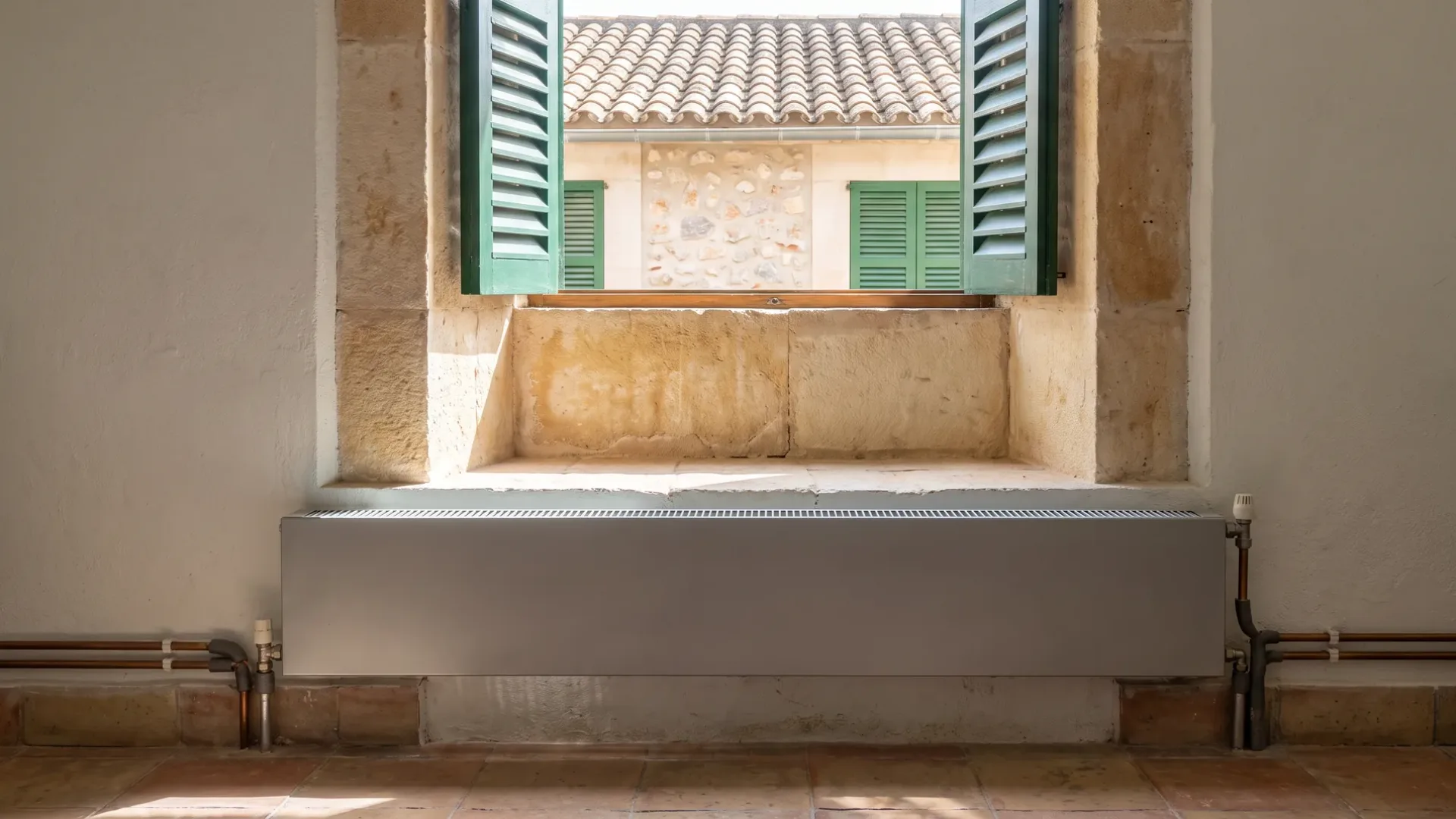
Heating Systems for Mallorca
Most properties here have no heating at all, or only a reversible split unit that was installed to cool and heats as an afterthought. The choice is not between nothing and the ideal: it is between what can fit in a building designed to shed heat rather than to keep it, and which you will use for four months of the year. Describe what you have now and we pass the request to air conditioning and heat pump companies that work with what exists.
request describes the job
companies see it
for you, always
obligation to accept
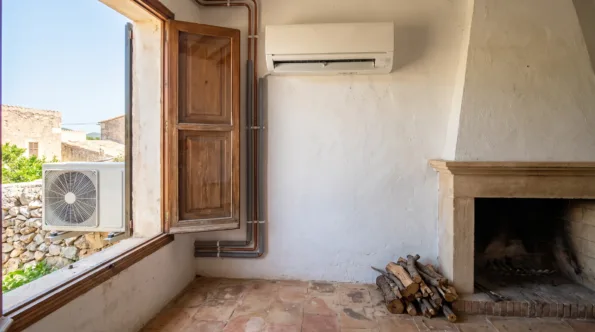
Why the choice matters on this island
Winter here is short and damp. A property unheated from May to November is cold on the inside when December arrives, not just to live in but to warm back up properly. That is the fundamental problem: the stone mass has cooled and the heating system has to fight both the weather and the building itself to bring it back up.
What you put in is not solving a year-round problem. It is solving a four-month problem in a building that was built for the opposite season. That changes which system makes sense. A boiler sized for a cold country runs at very low load here and is expensive to run; a system designed to run at part load is more appropriate. A system that takes hours to heat a house is less suited to a property used on weekends than one that does it in minutes.
The trade is always the same: something does warm air quickly, something else does it cheaply and slowly, something else is quiet or uses no grid electricity. Understanding what you are trading away is the first step.
The systems that exist here
- Reversible air conditioning, heating as a second mode of a cooling unit
- Air-to-water heat pumps, drawing heat from the outside air and feeding it to radiators or underfloor
- Underfloor heating, usually fed by a heat pump and running at low temperature
- Radiators and convectors, a conventional system fed by boiler, heat pump or solar
- Electric panel heaters, the simplest retrofit into an existing space
- Bottled gas heaters, portable or ducted, for properties without mains gas
- Solar thermal, usually supporting another system rather than replacing it
How to think about the choice
The question is not which is best, but which suits your building and how you use it.
-
01
What is there already
A radiator system exists and works. Replacing it is different from adding heating to a property that has none. An existing split unit heats and cools already. Doubling that with underfloor is different from choosing between them.
-
02
How the building is used
Full time, weekends only, or empty through winter all change the answer. A reversible unit that is switched off for seven months loses efficiency when asked to catch up; a system designed to hold a steady temperature suits a different pattern.
-
03
How fast it needs to be
Some systems take hours to heat a house, others minutes. Which matters depends on whether you arrive in a cold room and want comfort now, or live in it all season and can set it running in advance.
-
04
What the building will accept
A stone house with no internal walls cannot take underfloor pipes without opening the floor. A house with low ceilings cannot take a duct system. The building often decides first.
-
05
What runs the rest of the year
A system fed by a heat pump uses electricity all year. One fed by a boiler is off in summer. One that is both heating and cooling in the same room is different from one that handles them separately. These are not small details.
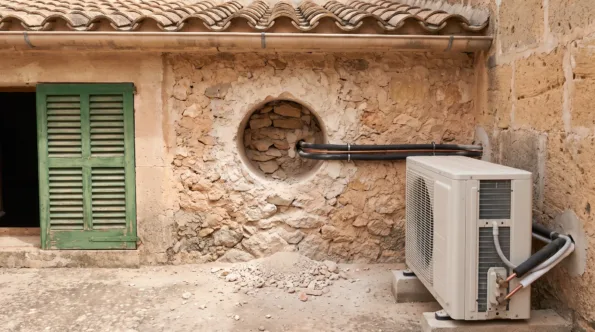
The retrofit problem that catches most choices
Most of these systems were designed for buildings that are built before the occupants arrive. A house built to a brief. Heating here goes into a building that is already finished, with walls and floors in place, doors in their frames and the kitchen and bathroom full of their own services. Running a pipe is not plugging a gap in the structure; it is cutting into walls and floors that were not designed for it.
That is why so many Mallorca properties stay unheated or end up with a reversible unit bolted to the outside. It is not because underfloor heating or radiators are bad, but because they solve the problem in a building where the solution is hard to install. Electric panels and portable heaters avoid that. They are less efficient, more expensive to run, and deliver worse comfort, but they go in without opening the house.
Understanding what a system needs to be put in is half the conversation. Some systems are fast to install and hard to hide. Others are invisible and take three weeks. Some need a separate plant room or a space for a water cylinder. Some cannot be installed while the property is occupied. The job is as much about the building as the system.
Related choices that move together
Which heating system you choose almost never stands alone.
Heat pump heating
Underfloor heating
Smart controls
What makes the prices for each one different
The cost guide carries the calculator and the island ranges. These are the variables behind them.
- The cost of the system itself, which varies wildly between types
- The cost of installation, which depends on what has to be opened and where pipes run
- Whether the property is occupied during the work, or can stand empty
- What is demolished and rebuilt, or can be hidden
- Electrical supply and whether an upgrade is needed
- How much servicing and maintenance each system will need
- The cost of running it all winter, which changes with the efficiency
- Whether other systems come in the same job, like water heating
How your request reaches a company
Mallorca Climate Control is a comparison service. A request for choosing a heating system goes to the air conditioning and heat pump companies on our list; they quote the work and carry it out, and any agreement is between you and the company you pick.
-
01
Describe the job
Tell us the property, roughly what you want and where it is. Photographs and a rough plan help, though neither is required.
-
02
We match it
The request goes to companies that work in your area and take on this kind of job at this size.
-
03
They quote you
Each company contacts you directly with its own price, timing and approach. We do not set any of it.
-
04
You compare and choose
Put the quotes side by side and take the one you want, or none of them. Using the site costs you nothing.
Does Mallorca need heating at all?
A house unheated from May to November becomes very damp inside. Damp drives mould, which damages the building and makes the air unhealthy. A heated house at an even temperature through winter avoids that. A weekend property that is closed up empty all winter needs less heating than one that is lived in, but it still needs some.
Is reversible air conditioning good enough for heating?
It works, and it is usually the cheapest to install because it is already there. The drawback is that it heats at low efficiency when the outside air is cold, it is loud when heating, and it switches off for months at a time. If you live with those trade-offs, it is fine. Many people do not.
Can two systems heat the same property?
Yes, and it is common. A reversible unit covers the main room quickly when it is needed, and underfloor or radiators provide background warmth through the season. The two run at different flow temperatures and the controls are separate, so the system gets more complex to manage.
What happens if heating fails in the middle of winter?
The house cools and damp builds. That is why servicing before winter is worth more than servicing during it, and why a second home needs a check in autumn. A failure discovered in February is a different experience from one found in August.
Is there any system that works without electricity?
Bottled gas and solid fuel do. Bottled gas is portable and works anywhere, but is expensive to run. It also dries the air, which adds to the damp problem rather than solving it. Solid fuel is even more work. Boilers on mains gas do not exist here.
Get quotes from heating companies
Describe the property and how you use it, and let several companies suggest what fits.