

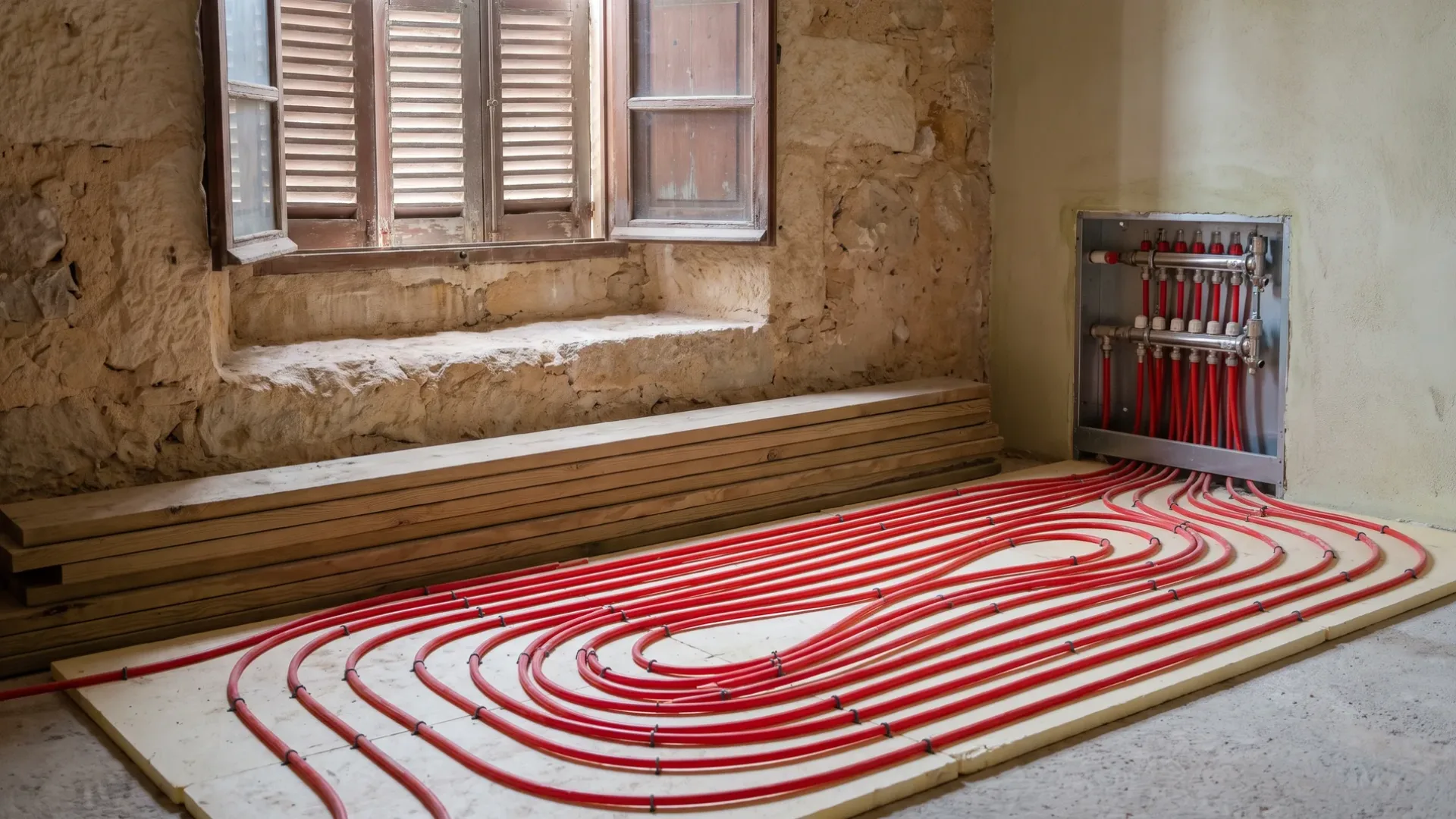
Underfloor Heating in Mallorca
Winter here is short, damp and colder indoors than visitors expect, because the houses were built to shed heat rather than to keep it. Underfloor heating answers that better than almost anything else: it warms the surface people stand on, runs quietly, and asks for water barely warmer than a bath. Describe the property and we pass the request to air conditioning and heat pump companies that install it.
request describes the job
companies see it
for you, always
obligation to accept
Why it suits the buildings here
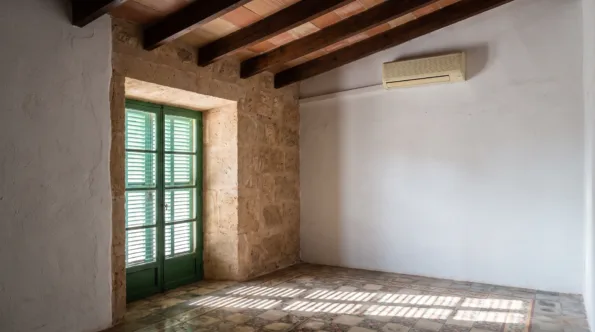
A stone or masonry house has a great deal of mass and very little insulation. Heating the air inside it is a losing argument: the air warms, the walls and the floor pull the heat straight back out of it, and the room feels cold while the thermostat says otherwise. Warming the floor instead works with the mass rather than against it. The slab holds the heat and gives it back slowly, which is exactly what a heavy building wants.
It also solves the comfort problem that heaters on the wall never do. Marès, terrazzo, hydraulic tile and polished concrete are all cold to the touch, and most of the year that is the point. In January it is the single thing people complain about, and it is the one thing a floor system fixes directly.
The trade is response time. A warm slab takes hours to come up and hours to fall, so it is a system for holding a house at a steady temperature through a season rather than for warming a room in twenty minutes. A property lived in through the winter suits it; one visited for a long weekend in February often does not.
What an underfloor heating request usually covers
- A heat loss assessment, room by room rather than for the property as a whole
- What the floor build-up is now, and how much height there is to work with
- Insulation under the pipes, without which the heat goes downwards
- Pipe layout and spacing, tighter where the room loses most
- The screed or the panel system the pipes sit in
- Manifolds, and somewhere sensible to put them
- What generates the heat, and at what flow temperature
- Zoning and controls, one per room or one per floor
- The floor finish, and whether it will pass heat or hold it back
- Commissioning, and the slow first warm-up a new screed needs
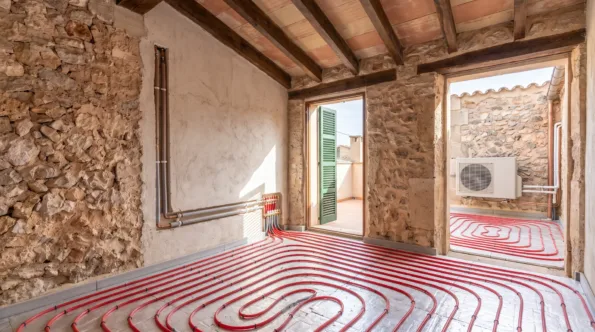
Retrofit is a height problem before it is anything else
In a new build or a full renovation the floor is open, so insulation, pipes and screed simply become part of the build-up and nobody notices the thickness. In a finished house that height has to come from somewhere, and the usual candidates are doorways, stair risers, thresholds onto terraces and the bottom of the kitchen units.
Low profile systems exist for exactly this and lose far less height than a traditional screed, at the cost of holding less heat and responding faster. Which of those is a drawback depends on how the property is used, and it is worth deciding deliberately rather than by whatever the installer happens to stock.
The other retrofit question is what is under the existing floor. An old house on the ground with no insulation below the slab will heat the earth as enthusiastically as it heats the room, and the insulation layer is not the place to economise.
What normally heats it
The floor is the emitter. Something has to warm the water, and that choice is usually made at the same time.
Heat pump
Heating and cooling systems
Smart climate control
What makes two underfloor quotes differ
The cost guide carries the calculator and the island ranges. These are the variables that move the price, and every one of them is a fair question to ask.
- How much of the property is being covered, and which rooms are left out
- Whether the floor is open already or has to be taken up
- Screed against a low profile panel system
- How much insulation goes underneath, and what it is
- Pipe spacing, which is a design decision and not a detail
- How many zones and how they are controlled
- Whether the floor finish is being replaced as part of the work
- What heats the water, and whether that is in this price or a separate one
- Whether the property is lived in while the work happens
How your request reaches a company
Mallorca Climate Control is a comparison service. A request for underfloor heating goes to the air conditioning and heat pump companies on our list; they quote the work and carry it out, and any agreement is between you and the company you pick.
-
01
Describe the job
Tell us the property, roughly what you want and where it is. Photographs and a rough plan help, though neither is required.
-
02
We match it
The request goes to companies that work in your area and take on this kind of job at this size.
-
03
They quote you
Each company contacts you directly with its own price, timing and approach. We do not set any of it.
-
04
You compare and choose
Put the quotes side by side and take the one you want, or none of them. Using the site costs you nothing.
Does underfloor heating work in an old stone house?
It is one of the few heating systems that genuinely suits one. The mass that makes a stone house hard to heat with warm air is what makes it hold heat well once the floor is warm. The obstacle is almost never the walls; it is the floor build-up and whether there is height to take the system.
Can it be installed without lifting the whole floor?
Not the pipes themselves, which have to sit under the finish. What varies is how much has to come up and how much height the system needs. Low profile systems are made for retrofit and lose far less height than a traditional screed, which is often what makes the job possible at all.
Can underfloor pipes cool the property in summer?
Some systems can circulate cool water through the same pipes, which takes the edge off a room, but it is not air conditioning. A floor cannot be run cold enough to cool properly without condensation forming on it, so cooling is normally handled by a separate system and the two are simply controlled together.
Which floor finishes suit it?
Stone, tile, terrazzo and polished concrete are ideal, because they pass heat readily and hold it. Thick timber and heavy insulating underlays work against the system, so the finish is worth agreeing before the design is fixed rather than after.
Is it expensive to run?
That depends almost entirely on what heats the water and how the system is controlled, not on the floor. A floor fed by a heat pump at a low flow temperature and left to hold a steady temperature is a different proposition from the same floor being switched off and asked to catch up each evening.
Get underfloor heating quotes
Describe the property once and let several companies price it against the same brief.