

Ventilation and Dehumidification in Mallorca
Two different jobs often get called the same thing. Ventilation exchanges the air in a room for air from outside. Dehumidification takes water out of the air already there and hands the same air back. A property can need one, the other, both or neither, and which it is depends entirely on where the moisture is coming from. Describe what the building is doing and we pass the request to air conditioning and heat pump companies that take on ventilation and drying work.
request describes the job
companies see it
for you, always
obligation to accept
A tight building has to be ventilated on purpose
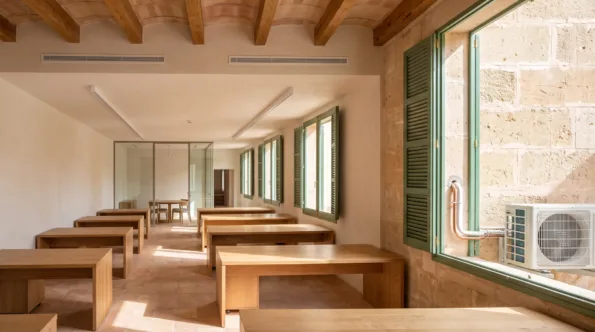
A building that leaks air ventilates itself. Loose shutters, old frames and an open flue move a great deal of air without anybody deciding that they should, and the water a household puts into the air by cooking, washing and drying clothes goes out with it. Seal those gaps, fit tight windows, and the building holds on to its heat and to its moisture at the same time.
That is the trade nobody mentions when the windows are priced. The rooms are quieter and cheaper to condition, and they are also keeping everything that used to drift away: bathroom steam, cooking smells, and the damp a household generates simply by living there. It shows up first as condensation on the coldest surface in the room, usually the glass, and after that in the corner of an outside wall.
Ventilation is what replaces that accident with a decision. At its simplest it is an extract fan that actually runs where the moisture is made. At the other end it is a system that supplies fresh air to bedrooms and living rooms, draws stale air out of bathrooms and kitchens, and recovers heat from the air it throws out so the fresh air does not arrive as a draught.
What comes under ventilation here
All of it tends to be settled in one conversation rather than five, which is why it sits on one page.
- Ventilation systems, from a single extract fan to a unit serving a floor
- Installation, and what has to be opened to run a duct through a finished house
- Humidity control, meaning holding a building in a range rather than reacting to it
- Dehumidification, where taking water out of the air is the job and not a by-product
- Indoor air quality, which in practice means filtration and getting fresh air in
- Extract where moisture is actually made: bathrooms, kitchens, utility rooms
- Sensors and controls, so equipment runs on a reading and not on somebody remembering
- What all of it should be doing in the months a property stands empty
Moving air and drying air are different answers
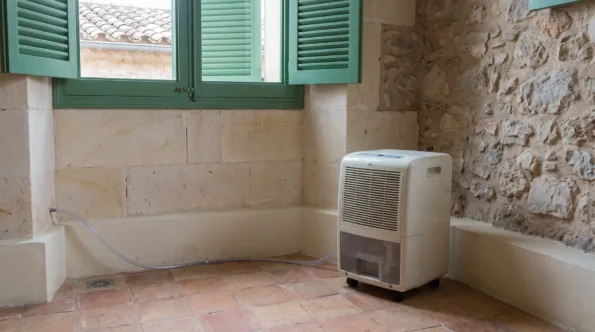
So the question worth answering first is where the water is coming from. Moisture made indoors, by showers, cooking and clothes drying on a rack, is best removed where it is produced, by something that extracts while it is happening. Moisture arriving through a wall or up through a floor is a building problem, and no equipment fixes it: that is work for a builder first and a climate company afterwards.
The two answers also fail in different ways. Exchanging air only dries a room while the air arriving is drier than the air leaving, and on a warm afternoon near the coast that is not a safe assumption. Drying the air deals with the water and with nothing else, so a room that is stale rather than wet is no better for it. That is why the diagnosis comes before the equipment, and it is the step a quote written without a visit tends to skip.
The third case is a property nobody is in, where the cooling that would otherwise be taking water out all summer is not running at all. What a building in that state should be doing is a subject of its own, and it is written on the second homes page rather than repeated here.
What to ask before you accept a price
Two companies can answer the same enquiry differently here, because the first decision is a diagnosis rather than a product. These questions make two quotes comparable.
- How it was established where the moisture is coming from
- Whether the fix extracts at the source or dries a whole room
- Where replacement air comes in, when air is being taken out
- What route any ductwork takes, and what has to be opened to run it
- Where a dehumidifier drains to, and what happens when that blocks
- How loud the equipment is in the room it serves, at night
- Whether it runs continuously or on a sensor, and what that does to the bill
- Who changes the filters, and how often they have to be changed
Where the rest of this is written
Second homes
Air conditioning and humidity
Maintenance
Ducted air conditioning
Smart climate control
Heating and cooling systems
How your request reaches a company
Mallorca Climate Control is a comparison service. A request for ventilation or dehumidification goes to the air conditioning and heat pump companies on our list; they quote the work and carry it out, and any agreement is between you and the company you pick.
-
01
Describe the job
Tell us the property, roughly what you want and where it is. Photographs and a rough plan help, though neither is required.
-
02
We match it
The request goes to companies that work in your area and take on this kind of job at this size.
-
03
They quote you
Each company contacts you directly with its own price, timing and approach. We do not set any of it.
-
04
You compare and choose
Put the quotes side by side and take the one you want, or none of them. Using the site costs you nothing.
Do I need ventilation or a dehumidifier?
It depends on whether the air is stale or simply wet. Condensation on the glass, a mark appearing in the corner of an outside wall and a smell of damp in a room that is otherwise used normally all point at moisture, and drying the air helps quickly. Stuffiness, cooking smells that hang about and a bathroom that steams up the moment somebody showers point at air that needs replacing rather than drying. Plenty of properties want some of both, which is the reason to have somebody look before anything is bought.
Does air conditioning ventilate a room?
Usually not. Split and multi-split systems recirculate the air already in the room: they cool it, condense some water out of it on the coil and blow it back. That is dehumidification of a sort, and it is not fresh air. If a room feels stale rather than hot, more cooling will not deal with it.
Will opening the windows do the same job?
Sometimes, and sometimes the opposite. On a dry, breezy day it is the cheapest ventilation available. On a warm humid afternoon it brings damp air into a building whose walls and floors are cooler than the air outside, and water comes out of that air onto those surfaces. That is why a closed house can end up drier than one that has been aired all afternoon, and why equipment running on a humidity reading beats a habit.
Is a dehumidifier enough for a property that stands empty?
It is a reasonable place to start, and what matters more is that whatever runs there reports back. A machine drying a closed house is only doing anything while its drain is clear and its tank is not full, and neither of those announces itself from another country. What a property left alone should be doing is covered on the second homes page.
What about filtration, dust and pollen?
A filter catches what is in the air passing through it, so the useful question is which air that is. On a recirculating indoor unit it is the air in the room going round again, and the filter is protecting the machine as much as the room. On a system bringing air in from outside, the grade of filter and who changes it are worth settling in the specification rather than finding out afterwards.
Get ventilation and dehumidification quotes
Describe the property and what it is doing, and let several companies price the same brief.