

Best Air Conditioning for a Villa in Mallorca
Key takeaways
- Whether the ceilings are open decides this more than anything else.
- Ducted suits a build or a deep renovation. Split suits a finished house.
- Zoning matters more than the badge on the equipment.
- A villa used in winter is a different question from one used in summer.
There is no single best system for a villa here, and anybody who names one without asking about the building is selling rather than advising. What there is, is a short set of questions whose answers narrow it to one sensible option almost every time.
The question that decides it
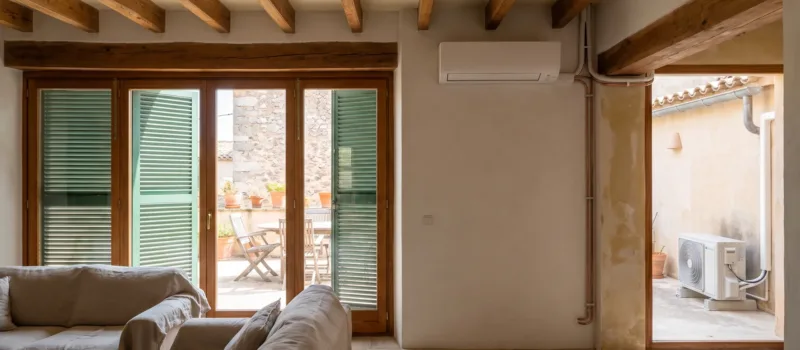
Are the ceilings open, or could they be? Ducted air conditioning needs a void to run in, so it is straightforward while a villa is being built or gutted and awkward to impossible afterwards. Split units need a wall, a pipe route and somewhere for the outdoor unit, which is why most retrofits end there.
Everything else is a refinement of that. It is worth answering honestly before comparing systems, because a ducted scheme forced into a finished house arrives with bulkheads across the living room and a price nobody expected.
What each option is actually good at
| Option | Good at | Poor at |
|---|---|---|
| Ducted | Whole-house control, nothing visible, quiet rooms | Retrofit into finished ceilings, low ceiling heights |
| Multi-split | One outdoor unit for several rooms, tidy outside | Surviving a fault, since everything stops together |
| Separate splits | Room-by-room sizing, one failure at a time, phasing | Keeping the outside of the building uncluttered |
| Air-to-water heat pump | Real winter heating, underfloor, hot water | Fast cooling, which it does not do |
The part most villas get wrong
Not the equipment. The zoning. A villa is rarely one climate: the west side is unbearable at six, the bedroom wing matters at night, and the guest accommodation is occupied for three weeks in August. Put all of that on one thermostat and the house is conditioned to suit whichever room the sensor sits in, which means most of the running cost is spent on rooms nobody is in.
Splitting the property into zones changes the bill far more than a more efficient outdoor unit would, and on a ducted system it has to be designed in rather than added. There is more on that under smart climate control.
Sizing, and the mistake that goes the other way
Undersized systems are obvious: they run all afternoon and never reach the setting. Oversized ones are worse in a way that is harder to see. They cool the air quickly, satisfy the thermostat, switch off before removing any moisture, and leave a room that is cold and clammy. They also short cycle, which is where compressors wear out.
A villa cannot be sized on floor area. A shaded room with small openings behaves nothing like a west-facing room of the same size with a glazed wall onto a terrace, and the second is where most of the load is. Ask any company what its sizing was based on; the answer separates them quickly.
Does the villa need heating too?
If it is used in winter, more than owners expect. Villas here are built to stay cool and are very good at it, so January indoors is colder than the outside temperature suggests. Reversible air conditioning takes the edge off; a property genuinely lived in through the winter usually wants a heat pump, often feeding a floor. A property used from May to October rarely justifies either.
A short way to decide
- Building or gutting the villa: ducted, zoned, designed in from the start.
- Finished villa, several rooms uncomfortable: separate or multi-split units.
- Finished villa, one outdoor position permitted: multi-split, sized for the total.
- Villa lived in through the winter: a heat pump for the heating, cooling alongside it.
- Villa used a few weeks a year: modest cooling, and remote control worth more than capacity.
The property side of this, room by room, is on the villa climate control page.
Is ducted always better if it is affordable?
It is usually the best result when the ceilings are open, because nothing is visible and the whole house can be controlled together. In a finished villa it stops being obviously better, because the work to create the routes can outweigh what it gains over well-placed split units.
Should the whole villa be air conditioned?
Often not. Many villas have three or four genuinely uncomfortable rooms and several that are fine, and solving the first properly beats spreading the same budget everywhere. What matters is that the routes and the electrical supply are planned for the whole house even if only part is installed now.
Does the brand matter?
Less than the installation. Reputable manufacturers are close on efficiency and reliability, and the differences that show up in a villa five years later are sizing, positioning, drainage and whether anybody services it. That is why this article is about the building rather than about equipment.
Can a system be added to later?
If it was planned for. Pipe routes and electrical capacity are cheap to oversize at installation and expensive to add afterwards, and a multi-split sized exactly for four rooms cannot take a fifth without a new outdoor unit. Say at the start if more rooms may follow.
This might be interesting to you
Air Conditioning for a Holiday Home in Mallorca
What to do with a climate system in a house you are in for six weeks a year, arranged as a calendar ...
Heat Pump or Air Conditioning: Which Does a Property Need?
The question contains a trap, because most air conditioning is already a heat pump. Here is the comp...
How to Reduce What Air Conditioning Costs to Run
Ordered by how much each one actually saves, which is close to the opposite of how this advice is us...
Heat Pumps in Mallorca: A Complete Guide
What a heat pump is, why the island climate suits them, and the difference between the two kinds tha...