

Commercial Climate Control in Mallorca
In a house a system failing is uncomfortable. In a dining room, a shop or a floor of bedrooms it is money for every hour it lasts, and the work almost always has to happen around opening rather than instead of it. Describe the premises and we pass the request to air conditioning and heat pump companies that take on commercial work.
request describes the job
companies see it
for you, always
obligation to accept
What makes a commercial job different
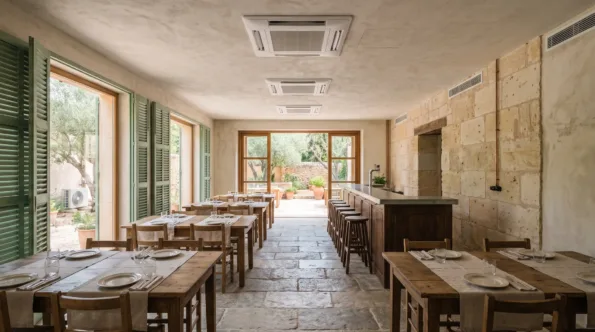
Occupancy is the first difference, and it changes the sizing entirely. A restaurant at capacity has a room full of people, a kitchen pushing heat through a doorway and a door opening every two minutes. A shop on a hot afternoon has a glazed front and a crowd. Neither behaves like a living room of the same floor area, and a system sized as though it does will be at full output by one o clock and behind for the rest of the day.
The second is the timetable. Work happens outside opening hours or between seasons, and that is a constraint on the price rather than a detail. A quote assuming a closed building and a quote assuming evenings and Sundays are not the same quote, and the difference is not the equipment.
The third is that somebody has to keep it running afterwards. Commercial premises need a service arrangement more than any private property does, because the cost of a failure is not measured in comfort. What that arrangement covers is worth agreeing in the same conversation as the installation.
The premises this usually means
Hotels and apartments
Restaurants and bars
Offices
What a commercial request usually has to state
The more of this is in the first description, the more comparable the quotes come back.
- What the premises are and how many people are in them at peak
- Opening hours, and when work may actually happen
- Whether there is a closed season, and when it falls
- What is installed now, its age, and what it does badly
- Kitchen or process heat, and any extraction already in place
- Which spaces need separate control and which can share
- Whether the building is owned or leased, and what the lease allows
- Where plant can go, and what may be visible from outside
- Whether ventilation and fresh air are part of the brief or separate
- What service arrangement is wanted once it is running
How a commercial project usually runs
The survey carries more weight here than on any other page of this site, because the load is about people rather than about square metres.
-
01
Survey and load
Occupancy at peak, heat from equipment and lighting, glazing, orientation and how doors are used. Measured for the busy hour, not the average one.
-
02
Zoning and control strategy
Which spaces are controlled by staff, which by guests, and which by nobody. On hospitality this is as important as the plant.
-
03
Plant and routes
Where the equipment stands, how it is reached for servicing, and what may be seen or heard from a terrace, a street or a neighbour.
-
04
Programme against the calendar
The work is fitted into closures, quiet weeks or nights. This is agreed before it is priced, because it changes the price.
-
05
Installation and commissioning
Phased where the premises stay open, with the system balanced and proven under something like real load rather than in an empty room.
-
06
Handover and servicing
Who operates it, what staff may change, and what the ongoing service arrangement covers.
Getting the control strategy right matters more than the plant
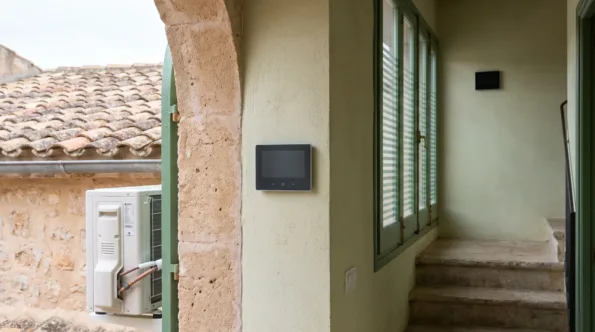
The commonest commercial complaint is not that a system is too small. It is that everybody can reach it. A thermostat within reach of guests or staff gets set to its limit in both directions all day, and a system that is constantly being overridden never settles anywhere and runs far more than it needs to.
The answer is rarely to hide the controls entirely. It is to decide which spaces are genuinely adjustable and by whom, to put limits on the range where that is appropriate, and to keep the plant control separate from the room control. Guests should be able to change their own room; nobody should be able to change the restaurant from a table beside it.
The same reasoning applies to schedules. A building that is conditioned from eight until midnight because that is what was set at handover, in a business that closes at four two days a week, is spending money nobody decided to spend.
Related
Smart climate control
How your request reaches a company
Mallorca Climate Control is a comparison service. A request for a commercial climate control project goes to the air conditioning and heat pump companies on our list; they quote the work and carry it out, and any agreement is between you and the company you pick.
-
01
Describe the job
Tell us the property, roughly what you want and where it is. Photographs and a rough plan help, though neither is required.
-
02
We match it
The request goes to companies that work in your area and take on this kind of job at this size.
-
03
They quote you
Each company contacts you directly with its own price, timing and approach. We do not set any of it.
-
04
You compare and choose
Put the quotes side by side and take the one you want, or none of them. Using the site costs you nothing.
Can the work be done while we stay open?
Usually, in phases, and it takes longer and costs more than the same work in an empty building. Where a business has a closed season, that window is worth planning around a year ahead, because the companies that keep to dates are committed long before it opens.
How is a commercial system sized?
On the load at the busy hour, which is mostly people and equipment rather than the building. A room with forty covers, a kitchen next door and a door onto the street has a very different load from the same room empty, and a system sized on floor area alone will be behind by early afternoon.
Do hotel rooms need individual control?
Guests expect it, and it also reduces running cost, because a room nobody is in is not being conditioned to a guest preference. What matters is that individual control has sensible limits and links to occupancy, otherwise every window in the building is open with the system running.
Is ventilation part of this?
It is a separate function from cooling, and in premises with people, cooking or smoke it is often the more important one. Say whether it is in the brief, because a quote for cooling alone in a space that also needs air changed is answering half the question.
What should a commercial service arrangement cover?
At minimum, how often somebody attends, what is checked and cleaned on each visit, what happens when something fails between visits, and who holds the spares for the equipment installed. Compare those four across the offers you get rather than the headline price.
Get commercial climate control quotes
Describe the premises and how they are used, and let several companies price the same brief.