

Air Conditioning Installation in Mallorca
A new system is decided by the building long before it is decided by the equipment. What the walls are made of, where the sun lands in the afternoon, whether there is a ceiling void, and where an outdoor unit can legally and physically stand all narrow the options before anybody names a machine. Describe the property and we pass the request to air conditioning and heat pump companies in your area.
request describes the job
companies see it
for you, always
obligation to accept
What an installation actually involves
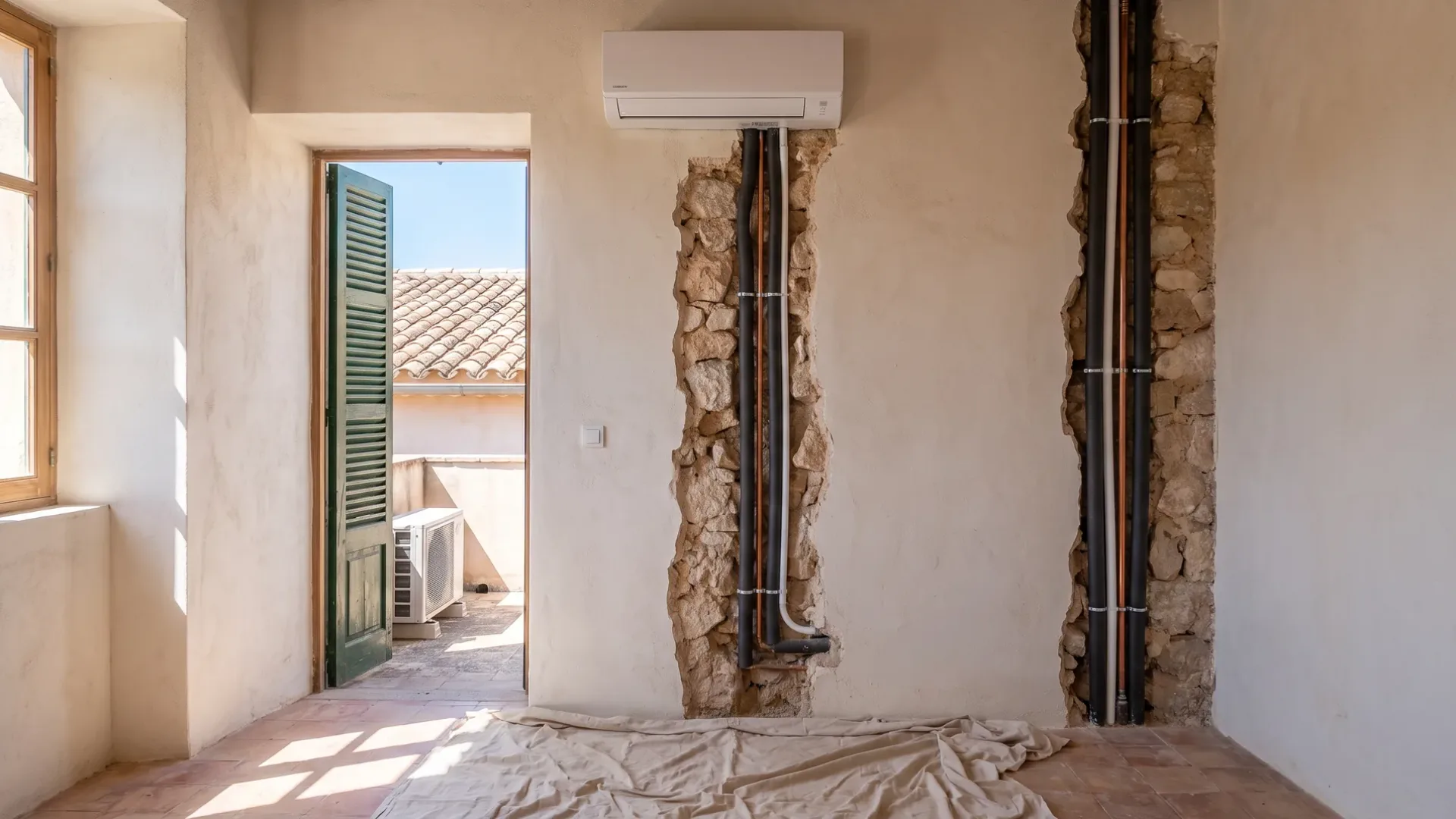
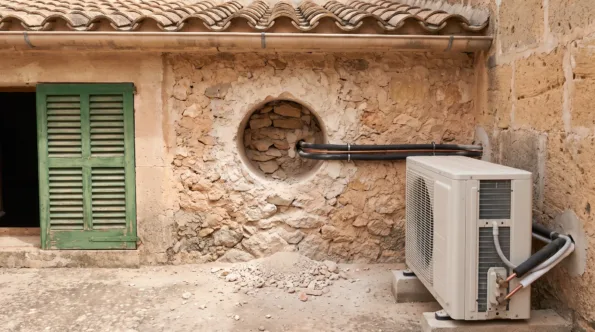
The visible part is small. An indoor unit or a grille, a controller on the wall, and an outdoor unit somewhere it can breathe. Everything else is the work: refrigerant pipework between the two, a condensate drain that has to fall the whole way, a power supply sized for the load, and whatever has to be opened and made good again to run all three.
That is why the same equipment can be a morning in one property and a week in another. On a new wall with the outdoor unit going directly behind it, the route is short and nothing is hidden. In a finished house where the plant has to sit on the roof and the pipe has to reach a bedroom on the other side, the route is the job.
A company that has looked at the property will describe that route before it prices it. A quote that names only the equipment has priced the easy part and left the rest to be discovered.
What an installation request usually covers
- A look at the property and which rooms are actually a problem
- Sizing, worked out from the fabric and the glazing rather than the floor area
- The choice between ducted, split and multi-split for this building
- Where the outdoor unit stands, and what it stands on
- The pipe route, and what has to be opened to run it
- A condensate drain with a fall all the way to somewhere sensible
- Electrical supply, and whether the existing one carries the load
- Controls, and whether the rooms are one zone or several
- Removal of any old equipment and the refrigerant in it
- Making good, and the paperwork for the connection
How an installation usually runs
The order matters. The decisions at the top are cheap to change and the ones at the bottom are not.
-
01
Survey
Somebody walks the property, looks at the glazing, the orientation and the construction, and finds out where an outdoor unit can go. This is also when the awkward answers surface.
-
02
Sizing and system choice
The capacity is calculated and the system type follows from the building. A ceiling void points one way, a finished plaster ceiling another.
-
03
Routes and positions agreed
Where the pipe runs, where the drain falls to, where the grilles or the indoor units sit, and what has to be opened. Agree this in writing; it is the part that surprises people.
-
04
First fix
Pipework, drain and cabling installed, and anything structural or electrical done while the walls and ceilings are still open.
-
05
Equipment and commissioning
Units mounted, the system charged and tested, controls set up, and the flow and temperatures checked under load rather than assumed.
-
06
Making good and handover
Plaster, paint and trims, the old equipment taken away, and the paperwork for the electrical connection.
Sizing is where installations go wrong
An undersized system runs continuously in August and never reaches the temperature it is set to. An oversized one is worse in a way that is harder to see: it cools the air fast, satisfies the thermostat, switches off before it has removed any moisture, and leaves a room that is cold and clammy. It also short cycles, which is the fastest way to wear out a compressor.
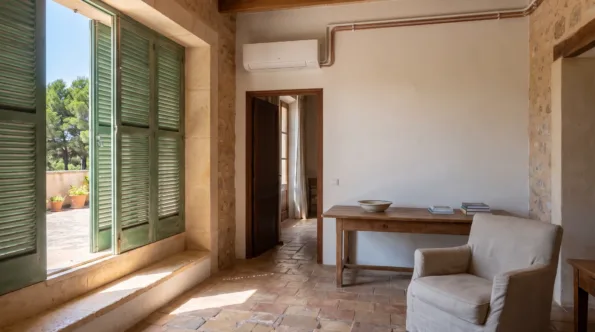
Floor area alone cannot tell you which you have. A shaded ground floor room with small openings and half a metre of stone behaves nothing like a west-facing room of the same size with a glazed wall onto a terrace, and the second one is where most of the load is.
This is worth asking about directly, because the answer separates companies quickly. Ask what the sizing was based on. Glazing, orientation, insulation, ceiling height and how the rooms are actually used is a proper answer. Square metres alone is not.
Which system suits the property
The three routes most installations take, and what usually decides between them.
Ducted
Split and multi-split
Heat pump
What makes two quotes for the same property differ
A figure that is not yours is worse than none, so the ranges live on the cost guide with the calculator that produces them. These are the variables that actually move a price, and you can ask about every one of them.
- How many indoor units or zones the property is being given
- Ducted against split, which is a different quantity of work rather than a different machine
- How far the outdoor unit is from the rooms it serves
- Whether the route runs through open ceilings or through finished ones
- Whether the electrical supply needs upgrading before anything is connected
- Whether an old system is being removed and disposed of
- How much making good is included, and to what standard
- Whether heating is part of the specification or only cooling
- Whether zoning and smart controls are in the price or added later
- What the company includes after commissioning, and for how long
How your request reaches a company
Mallorca Climate Control is a comparison service. A request for an air conditioning installation goes to the air conditioning and heat pump companies on our list; they quote the work and carry it out, and any agreement is between you and the company you pick.
-
01
Describe the job
Tell us the property, roughly what you want and where it is. Photographs and a rough plan help, though neither is required.
-
02
We match it
The request goes to companies that work in your area and take on this kind of job at this size.
-
03
They quote you
Each company contacts you directly with its own price, timing and approach. We do not set any of it.
-
04
You compare and choose
Put the quotes side by side and take the one you want, or none of them. Using the site costs you nothing.
How long does an air conditioning installation take?
A single split unit on an outside wall is usually a day. A multi-split serving several rooms in a finished house is longer, because the pipe routes have to be opened and made good. A ducted system in an existing property is longer again and is normally done alongside other work rather than on its own.
Can air conditioning be installed without opening the walls?
Sometimes. Where the outdoor unit can sit directly behind the indoor one, the pipe run is short and can often be boxed rather than chased. Once the two are on opposite sides of the property, the route has to go somewhere, and the honest options are a chase, a boxed duct or a different position for the outdoor unit.
Do I need permission to install air conditioning?
It depends where the outdoor unit goes and what the building is. Anything visible from the street on a protected facade, and anything hanging on a shared elevation in a building with a community of owners, is worth settling before the survey rather than after. A company that works in your area will say what applies to your building.
Should the whole property be done at once?
Not necessarily, but the pipework and the electrical supply should be planned for the whole property even if only part of it is installed now. Adding a second phase to a system that was never sized for it is the expensive way to arrive at the same place.
Is it worth installing in winter?
The work is easier and companies are less stretched outside the season. The systems fitted now are the ones that will be running in August, and a fault found in February is a different experience from the same fault found in high summer.
Get air conditioning installation quotes
Describe the property once and let several companies price it against the same brief.