

Humidity Control
Moisture is a symptom, not a problem in itself. The question that matters is what is causing it: is the air actually too wet, or is the building just holding onto normal moisture because it is sealed and still? Do you fix it by removing water from the air, by exchanging the air for drier air, by running equipment continuously at low speed or by reacting to peaks as they happen. The answer comes from understanding where the moisture is coming from. Once you know that, the control strategy follows. Let air conditioning and heat pump companies help you design and install the monitoring and equipment that keeps a building in the range you want.
request describes the job
companies see it
for you, always
obligation to accept
Holding a range instead of reacting to peaks
A property with no humidity control runs extract fans when somebody remembers to turn them on, or when condensation shows up on the glass. By then the water is already in the room and on the surfaces. This is reactive: you see the symptom and you react to it. The bathroom is wet, you turn on the fan, some water leaves, and then you turn it off.
A property with humidity control runs something continuously at low speed or runs it whenever a sensor says the air has crossed a set point. If the set point is 60% relative humidity, the system extracts whenever it rises above that, and stops when it falls below. This is preventative: the moisture never gets to the point where it becomes visible or smelly, because equipment is removing it all along.
The difference is visible in the building. Reactive systems catch problems after they start. Preventative systems keep the range steady. Which approach makes sense depends on how much moisture the building is making and whether the moisture is continuous or seasonal.
What shapes the strategy for a building
These factors decide whether to use sensors and continuous running, or hand-controlled extraction.
- Whether the building is airtight or loose (airtight needs continuous, loose can use reactive)
- How much moisture the occupants are making (cooking, showering, drying clothes, people in the space)
- Whether the moisture is continuous or seasonal (year-round living versus winter heating)
- The outside humidity when you want to extract (coastal air is often as damp as inside air)
- Whether the property stands empty for months (running costs money even when nobody is there)
- What happens to the air you are extracting (can you just throw it out, or does it need filtering)
- The cost of running equipment continuously versus the cost of water damage to a building
- Whether you want to be notified if humidity rises, or whether you want it handled automatically
How humidity control works in practice
Different building types need different approaches.
-
01
Set a target range
Usually between 40% and 60% relative humidity. Below 40% and the air feels dry. Above 60% and condensation begins appearing on cold surfaces. The exact target depends on the building and the season.
-
02
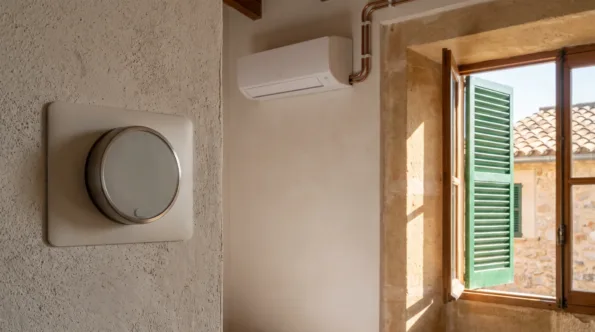
Install a sensor that reads humidity
The sensor sits in a central location and reports the reading to a controller. Some controllers use just humidity. Others also read CO2, temperature or moisture on specific surfaces. The more data the system has, the more precisely it can control.
-
03
Decide the response
When humidity rises above the set point, the controller can raise the fan speed of a ventilation system, turn on an extract fan, or even activate a dehumidifier if it is portable or fixed. When humidity falls below the target, it stops or slows down. The system can also learn and run anticipatory control: raising extraction before a shower happens, based on the time of day.
-
04
Monitor and adjust
After a week or two of running, you look at what the reading is actually doing. If it stays at 55% and you wanted 50%, you adjust the set point or the control logic. If it swings from 40% to 70%, the control response is too slow or the equipment is not strong enough.
Why the source of moisture decides the answer
Moisture made indoors, by cooking, showers and drying clothes on a rack, is best removed where it is made, by something that extracts in the bathroom and kitchen. A sensor at the centre of the building will see the peak much later, after the moisture has spread. Controlling moisture at the source means a smaller system can handle it, because you are not waiting for it to fill the whole space.
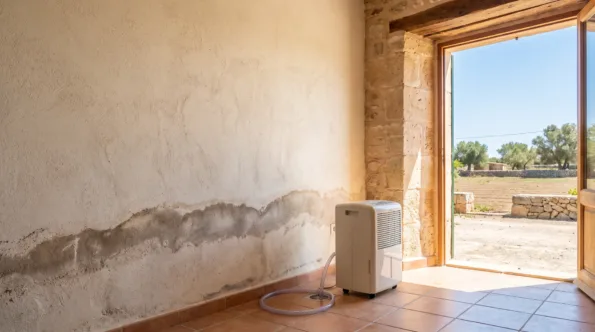
Moisture arriving through a wall, up through a floor or in from outside is a different case. You cannot extract at the source because the source is not in the room. The strategy has to be continuous low-speed ventilation to keep the whole space below the target, or a dehumidifier that runs all the time. Neither one stops the moisture from arriving, but they both keep it from accumulating.
The third case is property standing empty. Ventilation does almost nothing because there is nobody there making moisture, and the outside air in the warm season is as humid as indoor air is likely to get. The answer is different, which is why that case is covered on a separate page. Running continuous ventilation in an empty house costs money and catches no benefit.
The related equipment and questions
Ventilation systems to control
When dehumidification is the answer
Humidity and temperature science
Protecting a property that stands empty
Installation and sensors
Cost of different control strategies
How your request reaches a company
Mallorca Climate Control is a comparison service. A request for humidity control in a building goes to the air conditioning and heat pump companies on our list; they quote the work and carry it out, and any agreement is between you and the company you pick.
-
01
Describe the job
Tell us the property, roughly what you want and where it is. Photographs and a rough plan help, though neither is required.
-
02
We match it
The request goes to companies that work in your area and take on this kind of job at this size.
-
03
They quote you
Each company contacts you directly with its own price, timing and approach. We do not set any of it.
-
04
You compare and choose
Put the quotes side by side and take the one you want, or none of them. Using the site costs you nothing.
Should I control humidity with ventilation or with a dehumidifier?
It depends on where the water is coming from. If it is moisture made indoors, ventilation removes it while it is being made and costs less to run. If it is moisture arriving through the structure or on a humid afternoon when outside air is wetter than inside air, a dehumidifier that removes water from the air is the answer. Some properties want both.
What is a good humidity target for a house?
Between 40% and 60% is the usual range. Below 40% feels dry, above 60% favours mold and dust mites. The exact target depends on the building and the season. A property in the winter when heating is running usually sits naturally on the dry side. A property in summer near the coast naturally sits damp. What sensor control does is keep it in the range you choose rather than letting it drift.
Will a humidity sensor pay for itself in lower running costs?
If you are running equipment anyway, a sensor costs less than the electricity saved by not running it when humidity is low. If you are only reacting to peaks now, a sensor costs more but it prevents condensation damage. Compare the cost of the sensor against the cost of fixing water damage and the value of not being woken up by mold smell.
Do I need to tell a humidity sensor anything, or does it just work?
You set the target range once, usually between 40% and 60%. After that the sensor reads continuously and the controller runs the equipment to hold that range. Some systems can learn the building over time and run differently in summer and winter. The simplest ones just hold one set point all year.
Can a humidity sensor detect a leak?
A sudden jump in humidity in one room when the rest of the building is dry can indicate a leak or a burst pipe. Many sensors now alert you to unusual humidity patterns. That is worth asking about, because it is one of the few ways to know something is wrong in a property you visit rarely.
Get humidity control quotes
Describe the building and what it is doing, and let several companies design and quote the monitoring and control you need.