

When Should You Replace an Old Air Conditioning System?
Key takeaways
- Age alone is a poor guide. The pattern of faults is a good one.
- A leak on an obsolete refrigerant changes the arithmetic completely.
- A system that runs constantly and never arrives is telling you something.
- A replacement is the moment to fix what was wrong with the original installation.
There is no age at which a system becomes worthless, and a well-installed one that has been serviced can run for a long time. What matters is the pattern, and there are five signals worth reading.
Five signals, and what each one means
Repeat faults
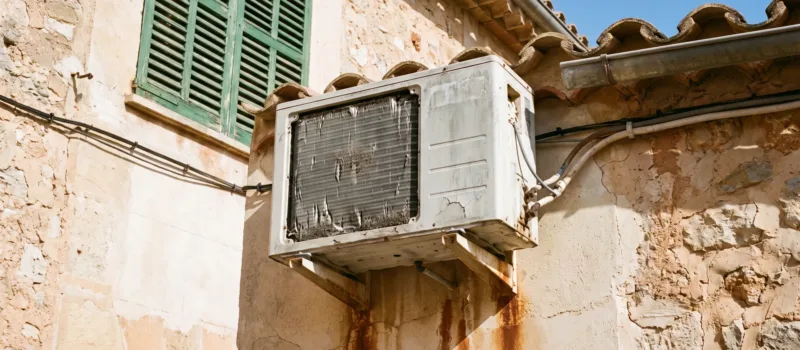
One fault on a system that has otherwise run well is a repair. A third fault in two summers, on different parts, is a machine telling you what the next few years look like. The next repair on that system buys months rather than years.
A leak on an old refrigerant
Refrigerant is not consumed, so a system that is low has a leak. On older equipment charged with gases that are no longer produced, that stops being a simple repair and becomes a supply question, and the answer gets worse every year. Ask what is in your system before agreeing to anything.
It runs and never arrives
A system running continuously without reaching its setting is behaving exactly as an undersized one does. Sometimes it has degraded. Often the house has changed around it: a terrace glazed, a wall removed, larger windows fitted, a guest wing brought back into use. Either way, more repairs will not fix it.
The bill has been climbing
Efficiency has moved a long way, and a corroded coil, a tired compressor and a system cycling badly all cost money every day they run. That argument never appears on a repair invoice and it is often the largest number in the comparison.
The repair quote is a real share of a new system
This is the honest test on a compressor in particular, because it is the expensive component. Ask for both prices rather than only the repair, and compare what each one leaves you with in five years.
When it is not time
It is worth being just as clear about the other side. A single electrical fault on an old but well-installed system is worth fixing. A blocked drain is worth fixing. A dirty coil is worth cleaning rather than replacing. And a system that has never been serviced is not a worn-out system; it is a neglected one, and the first thing to try is a proper service with the readings written down.
What a replacement should fix as well
Most systems being replaced now were specified when the property was different, or by somebody working quickly. The outdoor unit sits in a hot corner with no airflow, one machine tries to cool two rooms through a doorway, the controller is in the coolest place in the house, or the indoor unit blows straight at a bed.
None of that is worth fixing while the old system limps along and all of it is cheap to fix while the equipment is coming off the wall. Repositioning, splitting a zone, and putting the sensor somewhere representative are the changes owners are most glad of afterwards.
Before you decide
- Ask what refrigerant the system uses and what that means for repairs
- Ask for the repair price and a replacement price, not one of them
- Ask whether the current capacity still suits the property as it is today
- Ask what would change about the installation if it were done now
- Ask what can be reused: pipework, cabling, drains, brackets
The work itself is described on the replacement page. If the conclusion is that one fault needs fixing, that is repair.
How long should an air conditioning system last?
A well-installed system that is serviced runs for many years, and a badly installed one can fail early whatever is done to it. That is why age is a weak guide on its own: the pattern of faults, the refrigerant it uses and what it costs to run say far more.
Can I replace just the outdoor unit?
Rarely, and less often than people hope. Indoor and outdoor units are matched to each other, so pairing an old indoor unit with new outdoor plant usually means neither performs as intended and can void what the equipment supplier will stand behind.
Can the existing pipework be reused?
Sometimes, and it is worth asking rather than assuming either way. It depends on the pipe size, its condition, the route and what the old system ran, because older refrigerants used different oils. A company intending to reuse it should be able to say why that is safe.
Is a replacement disruptive?
Less than a first installation, because the routes usually exist. What people underestimate is the making good: the new indoor unit is rarely the same size and shape as the old one, so there is almost always plaster and paint at the end of it.
This might be interesting to you
Buying in Mallorca: What to Check About the Air Conditioning
What to look at during a viewing, what to ask the seller, and how to tell a system with years left f...
Heat Pumps in Mallorca: A Complete Guide
What a heat pump is, why the island climate suits them, and the difference between the two kinds tha...
How Often Should Air Conditioning Be Serviced in Mallorca?
Once a year is the baseline and this island argues for more. What a real service covers, and the par...
Ducted or Split Air Conditioning: How to Choose
A head-to-head between the two, what each one costs you in ways that are not money, and the properti...