

Heat Pump or Air Conditioning: Which Does a Property Need?
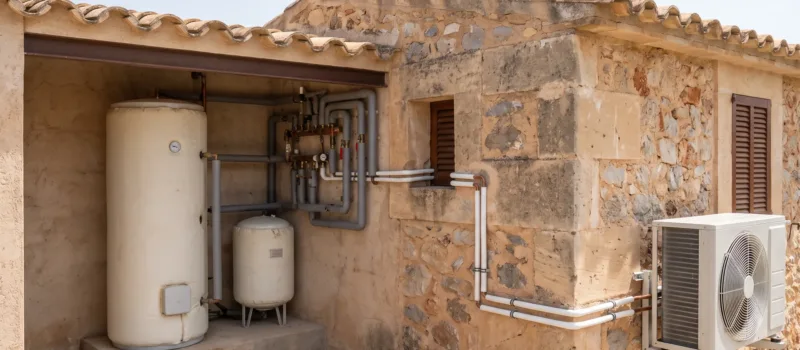
Key takeaways
- Most reversible air conditioning is already a heat pump.
- The real comparison is air-to-air against air-to-water.
- How many months a year somebody is in the property decides it.
- A summer property rarely justifies a heating system of its own.
This comparison gets asked constantly and it is built on a misunderstanding worth clearing up first: a reversible split system moves heat both ways, which makes it a heat pump. Comparing the two is comparing a category with one of its members.
What people mean by the question is real, though. They are asking whether the warmth a wall-mounted unit gives in winter is enough, or whether the property needs a system designed around heating. That is a good question and it has a clear answer.
The comparison people actually mean
| Reversible air conditioning | Air-to-water heat pump | |
|---|---|---|
| Primary job | Cooling, with heating as a second function | Heating, sometimes with limited cooling |
| How it heats | Warm air from a unit in the room | Warm water through a floor or fan coils |
| Feels like | A warm draught in one part of the room | A room that is evenly warm, and a warm floor |
| Response | Minutes | Hours |
| Hot water | No | Usually |
| Install cost | Lower | Higher, and it touches more of the building |
| Suits | Summer property, occasional winter use | Property occupied through the winter |
The fact that decides it
How many months of the year somebody is in the property. A house used from May to October has a cooling problem and almost no heating one, and installing a heating system for it means spending money on an empty building. A house lived in through January has both, and the second one is what people underestimate: villas here are built to stay cool and are very good at it, so winter indoors is colder than the outside temperature suggests.
Everything else follows. Between those extremes, a property used at weekends through the winter often does well on reversible units plus something that can be started remotely a day before an arrival, because the building takes time to come up.
Why warm air is not the same as a warm house
A wall unit blows warm air across a room, and in a heavy stone house that air meets walls and a floor that have been cold since November. The air warms, the fabric pulls the heat straight back out of it, and the room feels cold while the thermostat says otherwise. That is why owners of stone houses so often say that the heating on their air conditioning does not work.
A water-based system heats the fabric instead. It is slower, it is more expensive to install, and in a building with mass it is the difference between a room that feels warm and a room that measures warm.
Can one system do both?
Reversible air conditioning genuinely does both, at the level a summer property needs. An air-to-water heat pump can be arranged to cool through fan coils as well as heat, though it does not cool as quickly as air conditioning does and cooling through a floor is limited by condensation forming on it.
A great many properties here end up with both, sharing the outdoor plant or not: a heat pump handling the winter through a floor, and air conditioning handling August. It looks like duplication and rarely is, because one is sized for a February morning and the other for an August afternoon.
A short way to decide
- Summer property, empty in winter: reversible air conditioning, and nothing else.
- Weekends in winter: reversible units, plus remote control so the house starts early.
- Lived in through the winter, light modern construction: reversible units may still be enough.
- Lived in through the winter, stone or masonry: an air-to-water heat pump, usually feeding a floor.
- Hot water is part of the question: air-to-water, since the same machine can make it.
If the answer is the heat pump, the installation page covers what that involves and the guide explains the machine. If it is not yet clear, the heating and cooling systems page is written for exactly that.
Is a heat pump better than air conditioning?
They are not competing at the same job. Reversible air conditioning is the better and cheaper way to add cooling with some winter warmth. An air-to-water heat pump is the better way to heat a building properly and can make the hot water too. A property occupied all winter leans one way and a summer property leans the other.
Will air conditioning heat my house in winter?
It will warm the rooms it is in, and how well depends on the building. In light modern construction it is often enough. In a thick stone house it warms the air while the walls and floor stay cold, which is why it is so often described as not working.
Do I need both?
Many properties here end up with both, and it is less wasteful than it sounds. The heating system is sized for a cold morning and the cooling for a hot afternoon, which are different loads in opposite directions, and sharing plant between them is not always possible or sensible.
Which is cheaper to run?
Per unit of heat, a well-commissioned air-to-water system feeding a floor at a low temperature is usually the more efficient. Per euro spent, a property that only needs a few weeks of warmth will never recover the extra installation cost, which is why occupancy decides this rather than efficiency does.
This might be interesting to you
Air Conditioning and Humidity in Mallorca
Why a room at a reasonable temperature can still feel awful, and why a bigger machine is usually the...
How to Reduce What Air Conditioning Costs to Run
Ordered by how much each one actually saves, which is close to the opposite of how this advice is us...
When Should You Replace an Old Air Conditioning System?
The signals that mean the next repair is buying months rather than years, and the ones that mean the...
Ducted or Split Air Conditioning: How to Choose
A head-to-head between the two, what each one costs you in ways that are not money, and the properti...