

How to Reduce What Air Conditioning Costs to Run
Key takeaways
- Conditioning fewer rooms saves more than any thermostat setting.
- Heat stopped outside the glass never has to be removed.
- A choked coil costs money every day and is invisible.
- Turning it off and on twice a day usually costs more than leaving it steady.
Most advice on this subject starts with the easy things and never reaches the ones that matter. This is the other order: largest effect first, whether or not it is convenient.
1. Stop conditioning rooms nobody is in
This is the big one, and on a property of any size it dwarfs everything below it. A house on one thermostat conditions everything to suit whichever room the sensor is in, so bedrooms are cooled all afternoon in order that a living room is comfortable at six, and a guest wing nobody has entered since April is held at the same temperature as the kitchen.
Zoning fixes it properly. On split units each room is already its own zone and the work is in the controls; on a ducted system it means dampers, which is why it belongs in the design rather than added afterwards. Where zoning is not possible, simply closing doors and switching off the units in unused rooms recovers a good part of the same saving.
2. Stop the heat outside the glass
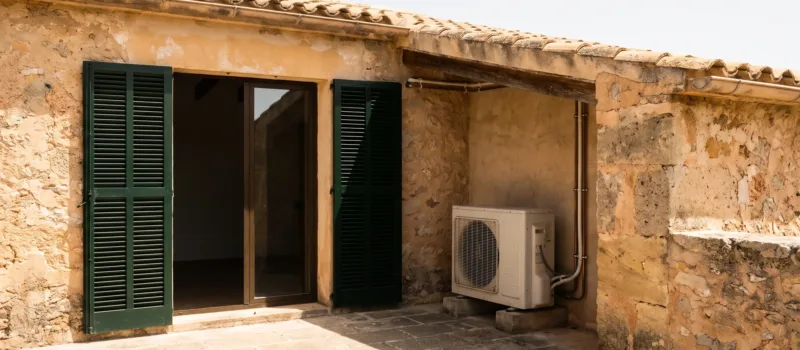
A square metre of unshaded glass facing the afternoon sun admits many times the heat of the wall beside it, and everything that gets in has to be removed by a machine that costs money to run. External shutters, an awning, a pergola or a deep overhang stop it before it arrives. Internal blinds help far less, because by then the energy is already in the room.
The same logic applies above. On a low house with an accessible roof space, insulation over the ceiling is usually the cheapest permanent reduction in load available.
3. Clean what the system breathes through
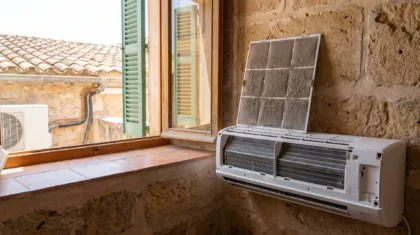
A choked filter and a coil packed with salt or fine sand make the system work harder for the same cooling, every hour it runs. It is invisible, it is gradual, and it is the reason a system that was comfortable three years ago is expensive now. Filters are an owner job and want monthly attention in the season here; the coils belong to a service.
The outdoor unit needs the same consideration. Furniture pushed against it, a shrub grown across it, or a decorative box built around it all reduce the airflow it depends on to reject heat.
4. Run it steadily rather than in bursts
This is the one that surprises people. Switching a system off during the day and asking it to catch up in the evening means it runs at full output against a building that has been gaining heat for eight hours, and in a heavy stone house the fabric has to be brought down as well as the air.
Holding a sensible temperature through the day usually uses less than the recovery does. On a lightweight modern property the balance is closer; on masonry it is not close at all.
5. Set a temperature you can live with, not the lowest one
Every degree lower is more work for the machine, and the difference between a comfortable setting and an aggressive one is a real share of the bill. This is where most advice starts, and it is fourth or fifth in effect rather than first.
It also matters less than people think for a related reason: a system set to its minimum does not cool a room faster. It cools it to a colder end point, having run for longer.
6. Keep the doors shut
A system holding a room against an open terrace door will lose, and it will be described as broken. This costs nothing to fix and is the single most common cause of a system that appears to underperform, particularly in a house full of guests.
What does not help as much as it is sold
- A more efficient outdoor unit, if the property is still conditioned as one zone
- Smart controls on a single unit in a single room
- Setting a lower temperature to cool a room faster, which it does not
- Internal blinds where external shading is possible
- Fans instead of cooling, which move air without removing heat or moisture
The controls half of this is on the smart climate control page, and the cleaning half on the maintenance page. If the system is simply old, whether to replace it is a separate question.
Is it cheaper to leave air conditioning running all day?
On a heavy building, usually yes, compared with switching it off and recovering in the evening. On a lightweight property the two are closer. What is never cheaper is running it at a low setting in rooms nobody is in, which is the thing that actually costs money.
Do smart thermostats save money?
They save it in proportion to how many rooms were previously being conditioned for nobody. On a house with several zones and variable occupancy the saving is real. On a single unit in a single occupied room, very little changes.
Does closing shutters really make a difference?
A large one, and larger than most owners expect, because it stops the heat entering rather than removing it afterwards. External shading is significantly more effective than internal blinds for exactly that reason.
Will a newer system be cheaper to run?
Usually somewhat, and less than the marketing suggests if the property is still controlled as a single zone. The order of that decision matters: sort the zoning, the shading and the servicing first, and then judge whether the equipment is the remaining problem.
This might be interesting to you
Planning Air Conditioning During a Property Renovation
Renovation is the only time the expensive options are cheap, and the decisions come far earlier in t...
Can Ducted Air Conditioning Go Into an Existing Villa?
Sometimes, and the answer is decided by what is above the ceilings rather than by budget. How to wor...
Best Air Conditioning for a Villa in Mallorca
Ducted, split or a heat pump, and the one question about the building that decides between them befo...
How Often Should Air Conditioning Be Serviced in Mallorca?
Once a year is the baseline and this island argues for more. What a real service covers, and the par...