

Heat Pumps in Mallorca: A Complete Guide
Key takeaways
- A heat pump moves heat rather than making it, so it delivers more energy than it uses.
- Most air conditioning here is already a heat pump. The word usually means something larger.
- The mild winters make this a better climate for them than the countries that argue about them.
- What it feeds decides its efficiency more than the machine does.
Heat pumps are argued about a great deal in northern Europe and much less here, and the reason is the climate. This guide covers what they are, which kind is being discussed, where they fit on a Mallorcan property and what goes wrong when they are installed badly.
What a heat pump is
It moves heat from one place to another rather than burning something to create it. In winter it takes heat out of the outside air, even air that feels cold, and delivers it indoors. In summer it does the reverse. Because it is moving energy rather than generating it, the heat it delivers is a multiple of the electricity it consumes.
That multiple falls as the outside air gets colder, which is the whole of the northern European argument. The coldest weather here is mild by those standards, which is why the argument barely applies.
The two things called a heat pump
| Air to air | Air to water | |
|---|---|---|
| What it heats | The air in a room | Water, which then heats the building |
| What it feeds | Indoor units on the wall or in a ceiling | Underfloor pipes, radiators, fan coils |
| Cooling | Yes, and quickly | Only in limited ways |
| Hot water | No | Usually, with a cylinder |
| Response | Minutes | Hours |
| Usually called | Air conditioning | A heat pump |
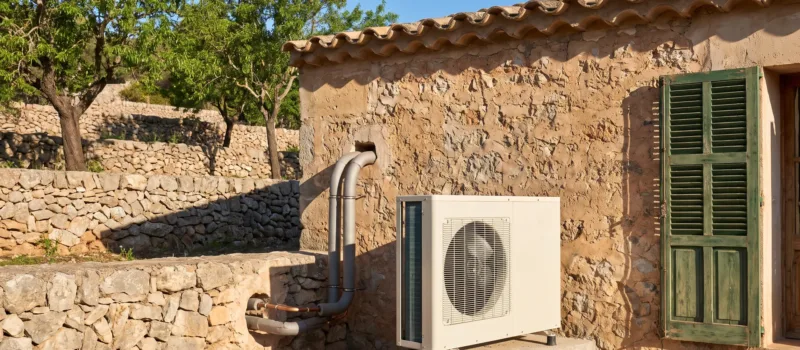
Almost every reversible split system sold on the island is an air-to-air heat pump. When somebody here says they are considering a heat pump, they usually mean the second column: a larger outdoor unit feeding water to a floor or to fan coils, and often making the hot water as well.
Why the island suits them
Three reasons. The winter is mild, so efficiency stays high in the months when heating is wanted. Most properties have no gas, so the alternative is usually electric panels, oil or bottled gas, all of which a heat pump beats comfortably. And the same machine covers cooling, which on a property that needs both is one installation rather than two.
The constraint is rarely the climate. It is space: somewhere outside for the unit, and somewhere inside for a cylinder and a buffer, which owners consistently underestimate.
What decides how well it runs
The flow temperature, which is set by whatever the system feeds. Underfloor pipes cover a large area, so they warm a room with water that is barely warm to the touch, and low flow temperature is exactly where a heat pump is most efficient. Radiators sized for a boiler want much hotter water, and asking a heat pump to produce it is asking it to work at its worst.
That is the trade in every retrofit: either the emitters get larger or the flow temperature stays high and the efficiency drops. It should be named in the quote rather than discovered in January.
The three mistakes that cost money
Running it like a boiler
A heat pump is most efficient holding a steady temperature, not being switched off twice a day and asked to catch up. Owners who schedule one like a gas boiler often conclude the machine is expensive, when the schedule is.
Oversizing
A unit larger than the building needs spends its life starting and stopping, which is where wear happens and efficiency is lost. The protection against it is a room-by-room heat loss calculation, and it is worth asking to see.
Lazy commissioning
Flow temperatures, weather compensation curves and controls set properly are the difference between a machine that pays for itself and one that does not. It is invisible on the day and visible on every bill afterwards.
Where to go from here
The installation side is on the heat pump installation page. If the question is really whether a heat pump or ordinary air conditioning suits the property, there is a separate comparison. And if the answer turns out to be a floor, that is underfloor heating.
Are heat pumps suitable for Mallorca?
The climate is close to ideal. Air source heat pumps lose efficiency as the outside air gets colder, and the coldest weather here is mild compared with the countries where that is a real objection. The harder questions are usually where the outdoor unit stands and where the cylinder goes.
How does a heat pump work?
It uses a refrigerant circuit to absorb heat at a low temperature outside and release it at a higher temperature inside, driven by a compressor. Because it is moving heat rather than creating it, the energy delivered is several times the electricity used. Reversing the circuit turns heating into cooling.
Can a heat pump replace a boiler?
Often, though rarely as a straight swap. The question is what the existing radiators need in order to heat the rooms. If they were sized for very hot water, either they get larger or the flow temperature stays high and efficiency falls. A company should say which of those it is assuming.
Do heat pumps work with underfloor heating?
That is the pairing they are happiest in, because a floor covers a large area and warms a room with water that is barely warm. Low flow temperature is where a heat pump is most efficient, so the two are usually specified together.
How noisy is the outdoor unit?
It runs a fan, so it is not silent, and it runs longest on the coldest nights. Position solves most of it: away from bedroom windows, off a resonant surface, and never boxed into a space with no airflow. Enclosing one to hide it makes it louder and less efficient at once.
This might be interesting to you
Planning Air Conditioning During a Property Renovation
Renovation is the only time the expensive options are cheap, and the decisions come far earlier in t...
Air Conditioning and Humidity in Mallorca
Why a room at a reasonable temperature can still feel awful, and why a bigger machine is usually the...
How to Reduce What Air Conditioning Costs to Run
Ordered by how much each one actually saves, which is close to the opposite of how this advice is us...
Ducted or Split Air Conditioning: How to Choose
A head-to-head between the two, what each one costs you in ways that are not money, and the properti...